
Outdoor Socket Installation and Garden Lighting: A Safe Guide
Adding an outdoor socket or garden lighting isn't a weekend DIY job. Here's the safe, legal way to do it, from RCDs and IP66 sockets to SWA cable and Part P.

By Yousif Al-Imari
Senior Engineer•22 July 2026
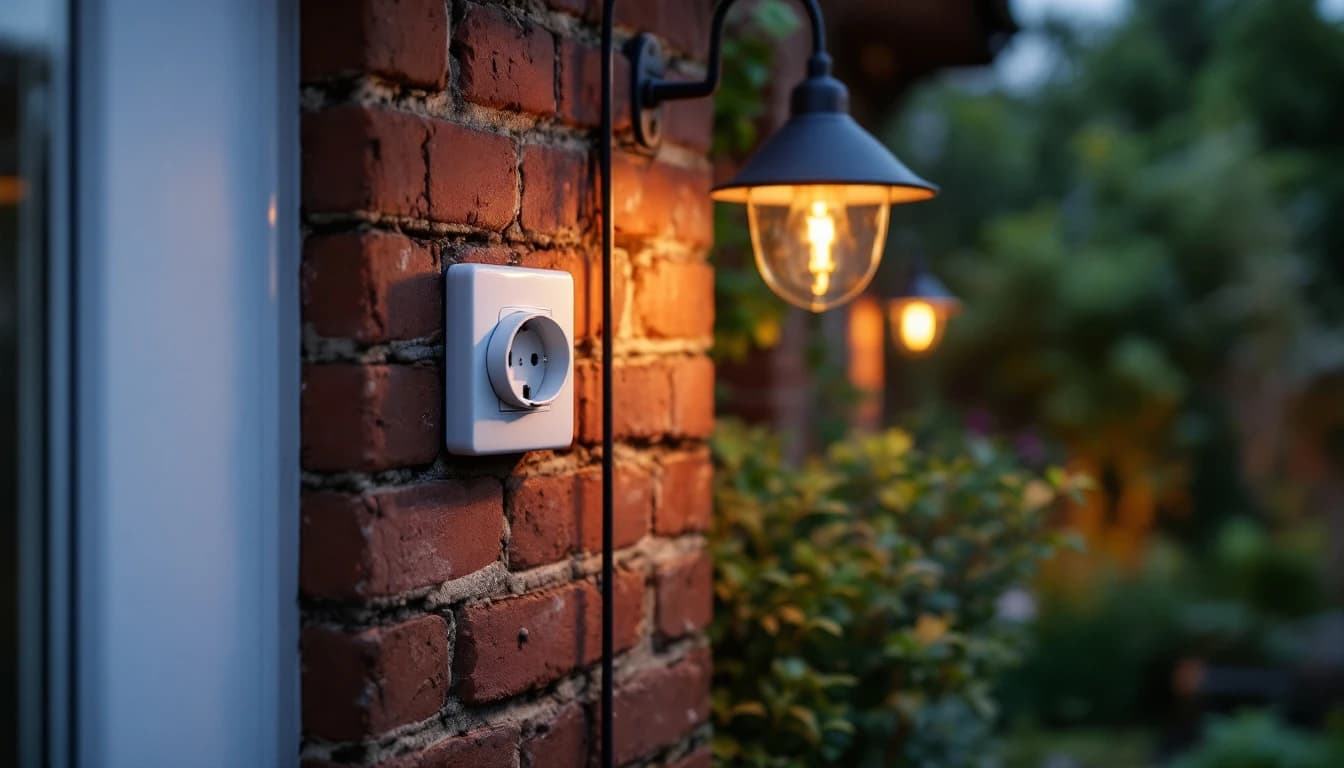
Thinking about adding an outdoor socket or some garden lighting? Here's the short version. A new outdoor socket or garden circuit is notifiable work under Part P of the Building Regulations, it has to be RCD protected, and it needs weatherproof kit rated for British weather. So it's a job for a registered electrician, not a Sunday afternoon with a drill and an optimistic attitude.
That can sound like overkill for one socket by the back door. It isn't. Outdoors, rain, wet ground and a lawnmower cable are all waiting to turn a small mistake into a real shock risk. This guide walks through what makes outdoor different, what the law actually says, and what a proper outdoor socket installation looks like start to finish.
What makes outdoor electrics different?
Indoors, your sockets live in a dry, stable, room-temperature world. Outdoors, none of that holds true.
Rain, hose spray, frost and morning damp all get into electrical connections. Wet ground also makes a shock far more dangerous, because your body becomes a much better path to earth. And garden cables get mowed over, dug up, or caught by a spade in a way indoor wiring behind your skirting never is.
So outdoor electrics have to do two jobs your indoor wiring doesn't: keep water out and survive physical knocks, all while cutting the power in a fraction of a second if a fault appears. That's why the socket, the cable and the protection are each a step up from what sits inside your walls.
Can I fit an outdoor socket myself?
In England, you can't legally just add one and forget about it. Running a new circuit out to the garden, or adding a new outdoor socket, is notifiable work under Part P of the Building Regulations.
The government's Approved Document P is the building regulation covering electrical safety in dwellings, and it explains when notification of work is required. The gov.uk guidance on building regulations approval spells out that jobs like replacing fuse boxes and connected electrics, or changing electrics near a bath or shower, need approval, and that "you do not need to get approval yourself if you use someone registered with a competent person scheme."
That last line matters. A registered electrician can self-certify the work and notify it on your behalf, so you never have to deal with building control directly. We're NICEIC registered, so that's handled as part of the job. Do it yourself without that route and you've got unnotified electrical work, which can hold up a house sale or give your insurer a reason to argue after a claim.
RCD protection isn't optional outdoors
An RCD, or residual current device, is the safety switch that cuts the power almost instantly if electricity starts leaking to earth. For example, through you.
Electrical Safety First, the UK charity, is blunt about it. Their advice is to use an RCD with all outdoor electrical equipment, because if you cut through an electrical lead, a simple job like mowing the lawn could kill you. Outdoor socket circuits need 30mA RCD protection under BS 7671, the UK wiring regulations. There's no version of this that skips it.
If your consumer unit is older and doesn't protect the right circuit, that gets sorted as part of the work, usually with an RCBO on the new garden circuit. If you want the detail on how these devices actually save lives, we cover it in our guide to what an RCD is and how it works.
IP ratings: why an indoor socket outside is dangerous
Every socket and light fitting carries an IP rating, two numbers that tell you how well it keeps out dust and water. The higher the second number, the more water it shrugs off.
A normal indoor socket is effectively IP20. Splash it and water goes straight to live parts. For anything mounted outside and exposed to weather, you want a proper weatherproof socket, typically IP66, sat in a sealed enclosure with a sprung cover over the plug. In a genuinely sheltered spot, like tucked under a deep eave, a slightly lower rating can be acceptable, but on an open wall that catches the rain, IP66 is the sensible standard.
This is one of the most common mistakes we're called out to fix. Someone screws a cheap indoor-grade socket to an outside wall, it fills with water over a wet winter, and the whole thing starts tripping or worse. The fitting has to be built for outdoors, not just sheltered by a bit of plastic.
The right cable, buried at the right depth
Flex and standard twin-and-earth cable belong indoors. For a run across the garden, especially anything buried, the correct choice is steel wire armoured cable, known as SWA.
SWA has a steel layer wrapped around the cores, so a garden fork or a stray spade meets armour instead of live copper. Buried cable also has to sit deep enough that normal digging won't reach it, protected along its length and marked with warning tape above the run so anyone digging later gets a clear signal to stop. Exact depth depends on the ground and what's above it, a lawn versus a driveway, so it's judged on site rather than to a single fixed number.
Runs to a shed, a garden office or a light at the far fence get planned properly: cable size matched to the load and the distance, glands terminating the armour correctly, and the circuit protected back at the board. Skip any of that and you get voltage drop, nuisance tripping, or a cable that fails the first time someone gardens near it.
Garden lighting: mains, low-voltage or solar?
Garden lighting splits into three broad types, and the right one depends on how much light you want and how permanent the setup is.
Mains (230V)
The brightest, most permanent option, and the one that needs an electrician. Mains garden lighting on a new circuit is the same notifiable, RCD-protected, SWA-cabled work as an outdoor socket. It's the way to go for wall lights, driveway posts, spike lights buried in borders, and anything you want switched from indoors. For ideas on fittings and placement, our roundup of the best outdoor lighting in the UK is a good starting point.
Low-voltage (12V)
Low-voltage systems run at 12V through a transformer, so the cable itself carries far less risk if it's nicked. They're popular for decking spots, path markers and border lighting, and the low-voltage cable doesn't need burying to the same standard as mains. The transformer still needs a safe, weatherproof supply, though, which usually means a properly installed outdoor socket or a fused outdoor connection to run it from.
Solar
Solar lights need no wiring at all, which makes them the easy win for a quick lift. The trade-off is output and reliability: they're dimmer, they fade in a British winter, and they depend on where the sun actually hits your garden. Fine for gentle ambience, not a replacement for proper task or security lighting.
Most gardens we wire end up as a mix. Mains for the lights that matter, a weatherproof outdoor socket or two for tools and low-voltage transformers, and solar wherever it's handy. If you want it designed and installed as one tidy job, that's our lighting installation service.
Hot tubs and garden offices: the higher-load jobs
A single socket is one thing. A hot tub or a fully powered garden office is a different scale of job.
A hot tub can pull a heavy, sustained load, often needing its own dedicated circuit rather than a spur off a nearby socket. Garden rooms used as offices or gyms usually want their own supply too, with sockets, lighting and sometimes data all fed from a small sub-board out there. Both are cases where cable size, the load on your consumer unit and RCD arrangement have to be worked out properly, not guessed.
This is firmly in the territory of a planned install. If you're looking at a hot tub, a garden studio or any serious garden power, our appliance and garden power installation is set up for exactly this, including checking whether your existing board can take the extra load or needs an upgrade first.
What a proper outdoor socket installation includes
When it's done right, an outdoor socket or garden circuit ticks every one of these off. It's worth knowing the list so you can tell a proper job from a bodge.
- Weatherproof fitting: an IP66-rated socket in a sealed enclosure with a sprung cover, mounted so water runs off, not in.
- 30mA RCD protection: the circuit protected against earth faults, usually via an RCBO at the consumer unit.
- Correct cable: SWA steel wire armoured cable for any buried or exposed run, sized for the load and distance.
- Safe burial and marking: buried deep enough to avoid normal digging, protected, with warning tape run above it.
- Proper terminations: the armour glanded and earthed correctly at both ends, no improvised joints.
- Load check: confirmation your consumer unit has a spare way and can carry the extra demand.
- Testing and certification: the circuit tested, an Electrical Installation Certificate issued, and the work notified under Part P.
Here's roughly how the job runs on the day:
- Assess the load you need and check the consumer unit for spare capacity.
- Plan the cleanest, safest cable route and where the socket or lights will sit.
- Isolate the supply, add the protective device, and run the SWA cable.
- Mount and gland the IP66 socket or fittings, then terminate everything correctly.
- Test the circuit, issue the certificate, and notify the work under Part P.
What does it cost?
Costs vary with the distance, whether cable needs burying, and the state of your consumer unit, so treat these as rough UK market guides rather than a quote.
- A single outdoor double socket, spurred near an existing indoor circuit: often in the low hundreds of pounds.
- A new dedicated garden circuit with buried SWA and a proper feed: more, because there's cable, trenching and board work involved.
- Hot tub or garden office supply: higher again, and sometimes bundled with a consumer unit upgrade if the board is full or older.
The single biggest cost driver is usually the cable run and whether the ground has to be dug. A socket a metre from an indoor circuit is quick. A supply to the bottom of a long garden is a proper install. For related numbers, our guide to the cost of adding extra plug sockets gives useful context. Whatever the job, get a fixed quote before anyone starts, so there are no surprises later.
Frequently asked questions
Can I fit an outdoor socket myself?
Not legally in England without either notifying building control yourself or using a registered electrician. A new outdoor socket or garden circuit is notifiable work under Part P of the Building Regulations, and a registered electrician can certify and notify it for you as part of the job.
Do outdoor sockets need to be RCD protected?
Yes. Outdoor socket circuits need 30mA RCD protection under BS 7671. Electrical Safety First advises using an RCD with all outdoor electrical equipment, because a cut lead while mowing could otherwise be fatal.
How deep does garden cable need to be buried?
Deep enough that normal digging won't reach it, using armoured (SWA) cable and warning tape run above it. There's no single legal figure that fits every garden, so the depth is judged on site based on the ground and what sits above the run, like a lawn versus a driveway.
Can I run an outdoor socket from an indoor one?
Sometimes, if the existing circuit can take it and it's done to standard with the right weatherproof fitting and RCD protection. But it still has to meet Part P and be tested and certified. An electrician will check whether spurring off is safe or whether a dedicated circuit is the better call.
Do I need Part P approval for low-voltage garden lighting?
The 12V lighting itself is low risk, but the mains supply feeding the transformer still has to be safe and compliant. If any new mains circuit or outdoor socket is added to run it, that part is notifiable and should be installed and certified by an electrician.
Based anywhere in London and want your garden power or lighting done properly, first time? Take a look at our sockets and switches service or call us on 020 3653 2600 for a straight answer and a fixed quote.
Related reading
Ceiling Fan Installation: Fixing, Wiring and Costs Explained
Swapping a pendant for a ceiling fan is a half day job when the fixing and wiring are right. Here's what a proper ceiling fan installation involves, and what it costs.
Read more
Smart Light Switches and the Missing Neutral Wire
Most UK light switches have no neutral, which is why smart switches fail. Here are the four ways round it and which one suits your house and your lights.
Read more
How Many Downlights Do I Need Per Room? A Spacing Guide
Work out how many downlights you need per room with a simple spacing rule, a lumens-per-square-metre guide by room, and a worked example for a London kitchen.
Read more