
The Best Outdoor and Garden Lighting for UK Homes (2026)
A buyer's guide to the best outdoor lighting for UK homes in 2026, from wall lights and path bollards to festoon, PIR floodlights and smart garden lighting.

By Yousif Al-Imari
Senior Engineer•27 June 2026
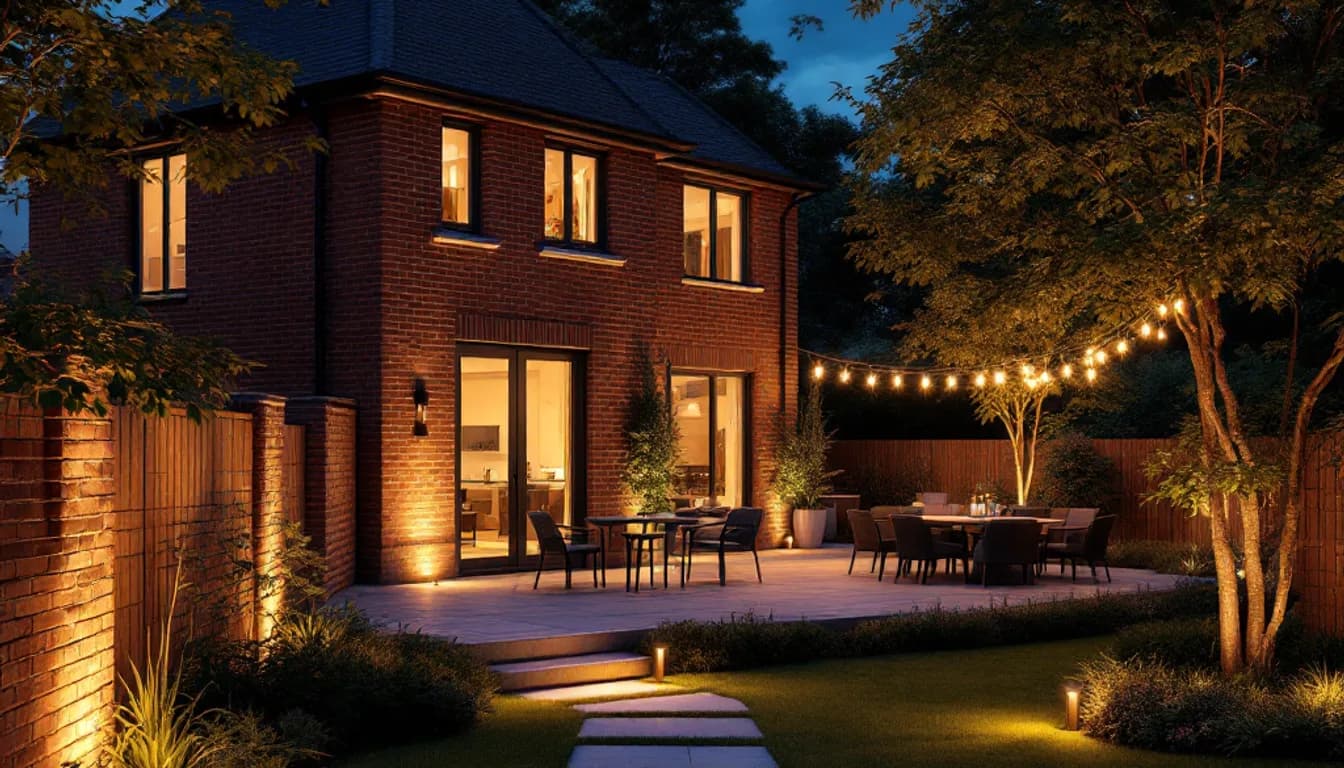
Good outdoor lighting isn't about one big floodlight blasting the whole garden. The gardens that actually look inviting after dark use several types of light doing different jobs, all wired to survive a British winter. That means the right fitting in the right spot, the correct IP rating for how exposed it is, and a circuit that's protected and signed off properly.
Below is a straight buyer's guide to the best outdoor lighting for UK homes in 2026, organised by type so it stays useful whatever the shops are pushing this season. I'll flag what each one is best for, and where you legitimately need an electrician rather than a screwdriver and some optimism.
What actually matters outdoors: IP ratings, RCDs and Part P
Before you fall in love with a fitting, three things decide whether it survives and whether it's legal.
IP rating. This is the two-digit number that tells you how well a fitting keeps out dust and water. For sheltered spots under an eave, porch or pergola, IP44 is usually fine. For anything taking direct rain and wind, such as a path light out in the open or a wall light on an exposed elevation, you want IP65. Ground-recessed lights that can sit in a puddle need to be rated higher still. When in doubt, go up, not down.
RCD protection. Water and electricity are a genuinely dangerous mix outdoors. Electrical Safety First is blunt about it and advises you to use a residual current device with all outdoor electrical equipment, because a fault in a wet garden can be fatal rather than just inconvenient. Any fixed outdoor lighting circuit we install is RCD protected as standard.
Part P. Installing a new outdoor electrical circuit is notifiable work under the Building Regulations. The Planning Portal confirms electrical installation must meet Approved Document P and can be self-certified through a Competent Person Scheme. As a NICEIC registered firm we can certify our own work, so you get the paperwork without a separate building control visit. Swapping a like-for-like fitting on an existing point is different, but a brand new garden circuit is not a DIY job.
If you want the wider job done properly, our lighting installation service covers the design and the certification, not just the fitting on the wall.
Outdoor wall lights: the everyday workhorse
Best for: front doors, back walls, patios and framing the house itself.
Wall lights are the most useful fitting most homes will buy. They light entrances, throw a glow over seating areas, and give the exterior of the house some shape after dark. Up-and-down "wash" fittings are the popular modern look because they graze light along the brickwork instead of dazzling you.
- Pick a warm colour temperature, around 2700K to 3000K, so it reads as cosy rather than car park.
- IP44 is fine under a porch, IP65 on an open elevation.
- UK brands like Ansell Lighting and Saxby both do broad exterior wall light ranges across budget, mid and premium tiers.
Path and bollard lights: guide the feet, not the eyes
Best for: driveways, paths, steps and border edges.
The job here is safe navigation without glare. Low bollards and stake lights sit at roughly knee height and pool light onto the ground where you're walking. The trick most people get wrong is spacing them in a rigid soldier's row. Stagger them, or run them down one side only, and the effect looks far more natural.
- Keep fittings low, roughly 30cm to 50cm, so nobody's staring into a bulb at eye level.
- Space them a couple of metres apart and overlap the pools of light rather than lighting every single point.
- Mains bollards give consistent output; solar stake lights are handy where running a cable is a pain, though winter performance is weaker.
Spotlights and uplighters: the drama merchants
Best for: trees, architectural planting, textured walls and garden features.
This is where a garden goes from lit to designed. An uplighter tucked at the base of a tree throws light up through the canopy and casts moving shadows. A recessed spike light grazing a stone wall picks out every bit of texture. Get the beam angle right: a narrow beam of roughly 15 to 30 degrees for spotlighting a specimen, a wider spread for washing across a wall or bed.
- Collingwood Lighting is a UK specialist worth a look for exterior spike lights and uplights.
- Uplighting a tree needs less output than a floodlight; more lumens is not automatically better.
- Recessed and in-ground fittings sit in the worst spot for water, so the IP rating and drainage detail really matter here.
If you like the recessed look outdoors, the same principles apply to the ones inside. We cover those on our LED spotlights and downlights page, and there's a breakdown of what fitting costs on our guide to the cost to install downlights.
Festoon lighting: instant atmosphere over a patio
Best for: dining areas, pergolas, courtyards and anywhere you entertain.
Festoon strings are the quickest way to make an outdoor space feel like somewhere you'd actually sit. Slung across a pergola or between the house and a post, warm LED festoon gives that relaxed, restaurant-terrace feel.
- Buy commercial-grade IP-rated festoon made for outdoors, not the flimsy seasonal stuff that dies after one wet autumn.
- Warm white around 2700K keeps it inviting.
- Fixed festoon on a dedicated outdoor circuit is tidier and safer long term than trailing an extension lead through the back door.
Security floodlights with PIR: light on demand
Best for: driveways, side returns, back gardens and dark access points.
A PIR sensor triggers the light only when it detects movement, which is better for security and your electricity bill than leaving a floodlight burning all night. LED floodlights have made these cheap to run and genuinely bright.
- Aim and angle it to cover the approach, not your neighbour's bedroom window.
- Set the sensitivity and timer so foxes and passing cats aren't putting on a light show at 3am.
- Go IP65 as standard, since these live in fully exposed positions.
Smart outdoor lighting: control from your phone
Best for: people who want scenes, schedules and app control across the whole garden.
Smart systems let you group fittings and switch between moods with a tap: a soft "evening dining" scene, a "security only" setting, a brighter "party" mode. Philips Hue runs a full outdoor smart lighting range, and it's a solid entry point if you want it to talk to the rest of the house.
- Stick to one ecosystem where you can, so everything sits under a single app.
- Plug-in kits are simple; a hardwired smart setup wants planning so switches and app control don't fight each other.
- Mains, low-voltage and solar all have a place; low-voltage 12V/24V systems are a common choice for garden runs.
Frequently asked questions
What IP rating do I need for outdoor lights?
IP44 is fine for sheltered spots under a porch, eave or pergola. For anything exposed to direct rain, such as open path lights or wall lights on an unsheltered elevation, use IP65. Ground-recessed fittings that can sit in water need a higher rating again.
Do outdoor lights need RCD protection?
Yes. Electrical Safety First advises using a residual current device with all outdoor electrical equipment, because a fault in a wet garden can cause a fatal shock. Any fixed outdoor lighting circuit should be RCD protected, and we fit that as standard.
Is installing garden lighting notifiable under Part P?
Installing a new outdoor electrical circuit is notifiable work under the Building Regulations and must meet Approved Document P. A registered electrician can self-certify it through a Competent Person Scheme, so you get the certificate without a separate building control application.
Are solar garden lights any good in the UK?
Modern solar lights have improved and are handy where running a cable is impractical, but output drops on short, dull winter days. For reliable, consistent lighting on paths, walls and features, mains or low-voltage wiring wins.
Can I install outdoor lighting myself?
Swapping a like-for-like fitting on an existing outdoor point is generally within reach for a competent DIYer. A brand new outdoor circuit involves buried cable, correct IP ratings and RCD protection, and is notifiable, so that's a job for a registered electrician.
Great outdoor lighting is a design job first and a wiring job second, and both need doing right for it to look good and stay safe. As a NICEIC registered London firm, Capital Electricians design, wire and install outdoor and garden lighting certified to BS 7671, with the outdoor circuits properly RCD protected and Part P compliant. If you want a scheme planned and installed without cutting corners, and you might also be sorting outdoor sockets and switches while you're at it, call us on 020 3653 2600.
Related reading
Smart Light Switches and the Missing Neutral Wire
Most UK light switches have no neutral, which is why smart switches fail. Here are the four ways round it and which one suits your house and your lights.
Read more
Outdoor Socket Installation and Garden Lighting: A Safe Guide
Adding an outdoor socket or garden lighting isn't a weekend DIY job. Here's the safe, legal way to do it, from RCDs and IP66 sockets to SWA cable and Part P.
Read more
How Many Downlights Do I Need Per Room? A Spacing Guide
Work out how many downlights you need per room with a simple spacing rule, a lumens-per-square-metre guide by room, and a worked example for a London kitchen.
Read more