
Smart Light Switches and the Missing Neutral Wire
Most UK light switches have no neutral, which is why smart switches fail. Here are the four ways round it and which one suits your house and your lights.

By Yousif Al-Imari
Senior Engineer•29 July 2026
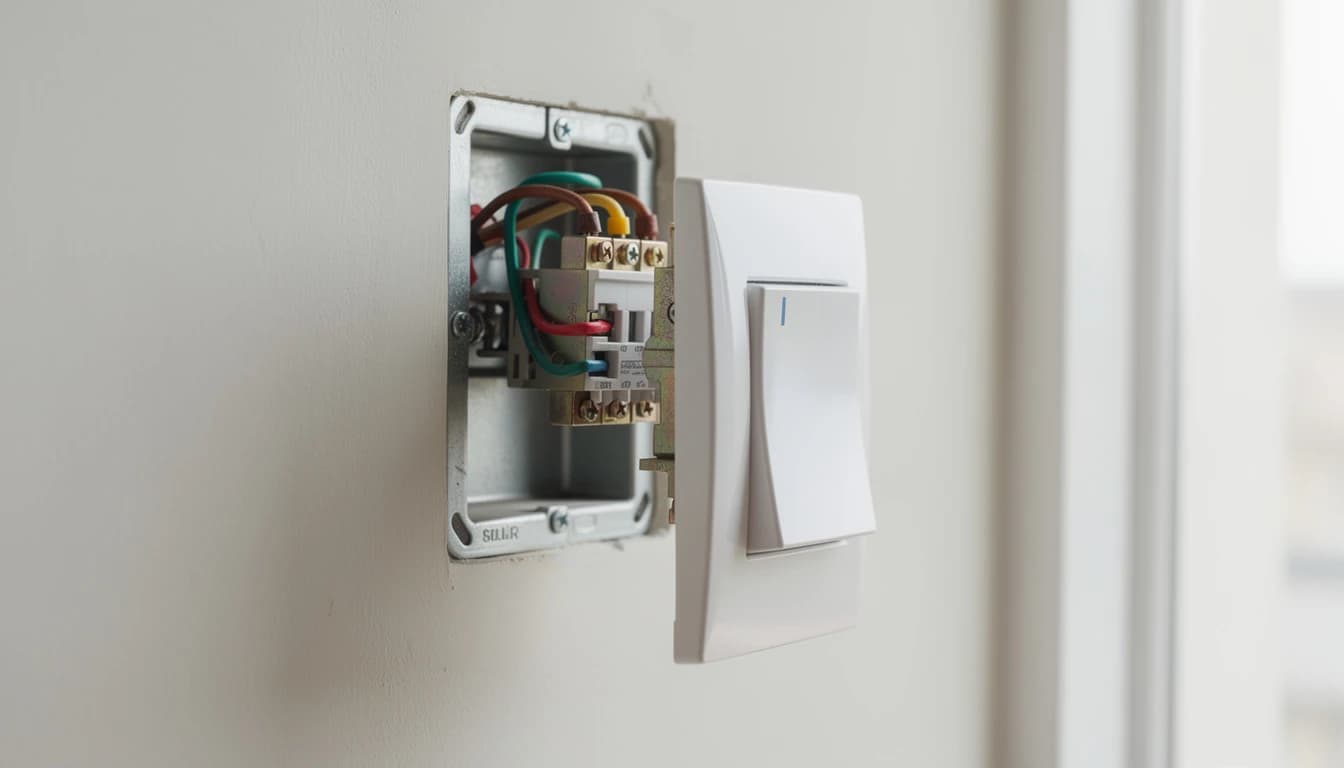
Most UK light switches don't have a neutral wire in the back box, which is exactly what a smart switch needs to power its electronics. You have four ways round it: buy a no-neutral smart switch, use smart bulbs instead, fit a smart module at the ceiling rose, or have a neutral run down to the switch. Which one suits you depends on your lights, your ceilings and how much disruption you'll accept.
This catches people out after they've already bought the switches. The box says it fits a standard back box, which is true, and says nothing about the wire that isn't there.
Why there's no neutral at your switch
British lighting has traditionally been wired loop-in at the ceiling rose. The permanent live, the neutral and the earth all meet up there. A single two core cable then drops to the switch carrying a live down and a switched live back up.
The switch is doing one job: breaking and remaking a live conductor. It has no electronics, so it never needed a neutral, and running one would have meant more copper in every house in the country for no benefit at the time.
That decision, sensible for decades, is why your switch box now contains two conductors and a smart switch wants three. Newer properties are increasingly wired with a neutral at the switch, and some installers have been doing it as standard for years in anticipation. Older London housing almost never has it.
One thing to be clear about: the brown sleeving on that second conductor doesn't make it a neutral. Both conductors in a switch drop are live, one permanently and one when the switch is on. Connecting a smart switch's neutral terminal to a switched live is a fault, not a workaround.
How to find out what you've got
The honest answer is to have someone look with the circuit isolated and a tester in hand. Pulling a faceplate off a live lighting circuit to peer inside is how people get a shock from a conductor they assumed was dead.
Some clues without touching anything:
- House built or rewired since roughly 2015: reasonable chance a neutral is present at switches.
- Downlights throughout with a loft above: the wiring is often more accessible, which changes your options.
- Original 1930s or Victorian property never rewired: assume no neutral, and assume no earth at the switch either.
- You already have a dimmer working happily: some dimmers run without a neutral, so this tells you less than you'd hope.
Electrical Safety First's smart home guidance puts it plainly: "if required, have smart technologies installed by a skilled, trained, and competent electrician who is familiar with the technology". The familiarity part is the bit that matters here, because the failure modes are specific to this kit.
Your four options
1. No-neutral smart switches
These draw a tiny trickle of current through the lamp itself to keep their radio and processor alive. Clever, and the reason they sometimes misbehave.
With LED lamps, that trickle can be enough to make the light glow faintly when it should be off, or flicker. Manufacturers supply a bypass capacitor to fit at the light fitting to absorb the leakage, which fixes it in most cases but means getting up to the fitting anyway.
They also have a minimum load. Two 4W LED lamps on a landing may fall below what the switch needs to function reliably. Check the minimum wattage in the specification before buying, not after.
Best for: retrofitting a few switches without touching ceilings, where the lights are a reasonable wattage.
2. Smart bulbs, dumb switch
Leave the wiring alone entirely and put the intelligence in the lamp. Cheapest to start, no electrician needed, works in any house.
The catch is the wall switch. Turn it off and the bulb loses power along with its brain, so the app stops working and anyone who flicks it out of habit breaks the system. Households solve this with a switch guard or by replacing the switch with a blanking plate and a battery remote, which is a slightly odd end state.
It's also poor value at scale. Twelve smart bulbs in a room with downlights costs more than doing the job properly, and every one is a device that eventually fails.
Best for: table lamps, single-fitting rooms, renting, or trying the idea before committing.
3. A smart module at the fitting
A small relay module goes in the ceiling rose or the downlight void, where the neutral is already present. Your existing wall switch stays exactly as it is and becomes an input to the module.
This is the option we recommend most often. You keep the switch plates you like, you get proper on and off rather than a permanently powered lamp, and there's no leakage current messing with LEDs. The wall switch keeps working normally if the network goes down, which is precisely what Electrical Safety First recommends when it advises having "a manual light that can be used if the system goes down".
You need access and space at the fitting. A generous ceiling rose is fine. A tight downlight housing in a plastered ceiling may not be.
Best for: keeping existing switches, getting the most reliable result, where the fitting can be reached.
4. Run a neutral to the switch
The thorough answer. A new cable from the rose to the switch, or the switch drop replaced with three core, and your switch box now has everything a smart switch wants.
It means lifting floorboards above or chasing a wall, so it's disruptive on its own but nearly free if the ceilings are already down or you're rewiring. If a rewire is on the cards in the next couple of years, specify neutrals at every switch position and the problem disappears permanently.
Best for: renovations, rewires, or a single switch position you really want to be smart.
The other missing wire
While the faceplate is off, there's a second thing worth knowing about older properties: often there's no earth conductor at the switch either. Lighting circuits wired before the 1960s frequently ran without one.
That's fine for a plastic switch plate. It's a problem the moment someone fits a brushed steel or brass plate, because exposed metal parts need an earth connection. It's also a problem for many smart switches, which have metal components or require an earth by their instructions.
People discover this halfway through a decorating project, with a box of expensive metal plates and no way to fit them safely. If your lighting has no earth, that's a finding worth acting on regardless, and it's one of the more common observations we record on inspections. Our post on EICR codes and what they mean covers how it gets classified.
Why smart lighting flickers and glows
The two complaints we hear after a smart lighting install are exactly the two you get from cheap dimmers: a faint glow when off, and flickering at low brightness.
Both come down to LED lamps being far more sensitive to small leakage currents than the filament bulbs the circuits were designed around. It isn't a fault in your wiring, and swapping the switch usually doesn't fix it either. The answer is a bypass, a compatible lamp, or moving the smart control to the fitting instead.
We've gone into the electrical detail in our post on why LED lights buzz or glow when off, and the related read on flickering lights covers the cases where it genuinely is a wiring fault.
Buying kit that will still work in five years
Smart lighting has a graveyard of discontinued hubs behind it. A few things that help.
- Buy from a reputable seller. Electrical Safety First advises to "only buy smart devices from a reputable retailer or manufacturer to avoid buying a fake or substandard product". Marketplace listings for unbranded switches are a genuine safety risk, not just a quality one.
- Register the product. The same guidance says to "register your device so you can be contacted easily if there is a safety recall".
- Favour open standards. Kit that speaks a common protocol survives a manufacturer losing interest.
- Insist on local control. If the lights only work when the internet does, you've made your house worse.
Whichever route you take, get the switches you're keeping wired correctly first. Our lighting installation work covers both the smart side and the ordinary business of making sure the circuit behind it is sound.
Frequently asked questions
Can I just connect the smart switch neutral to the switched live?
No. Both conductors in a standard switch drop are live, and connecting one to a neutral terminal creates a fault rather than a working circuit. It can damage the device and leave the installation unsafe.
Why does my LED glow faintly after fitting a no-neutral smart switch?
The switch is drawing a small current through the lamp to power itself, and modern LEDs need very little to produce a visible glow. Fitting the manufacturer's bypass capacitor at the light fitting normally clears it.
Do smart switches work with dimmable LEDs?
Only with lamps the manufacturer lists as compatible, and not all dimmable LEDs behave the same way. Mixing brands within one fitting is a common cause of flickering. Buy the lamps and the switch as a matched set where you can.
Is a smart module at the ceiling better than a smart switch?
Usually, if there's room for it. The module has a real neutral so there's no leakage current, and your existing wall switch keeps working normally, including when the network is down. Space at the fitting is the only real constraint.
Do I need an electrician to fit a smart light switch?
Replacing a switch is not itself notifiable work in England, but it involves working on a live circuit and, in older homes, often turns up a missing earth or an unexpected wiring arrangement. If you open the box and it doesn't look like the instructions, stop.
Will smart switches work if my wifi goes down?
Depends entirely on the system. Ones that run locally keep the wall switch working. Cloud-dependent ones can leave you unable to control the lights at all, which is why having a manual override matters.
Want smart lighting that works properly rather than half the time? See our lighting installation service or call 020 3653 2600. We'll check what's actually in your switch boxes first, then tell you which approach fits your house and price it up front.
Related reading
Outdoor Socket Installation and Garden Lighting: A Safe Guide
Adding an outdoor socket or garden lighting isn't a weekend DIY job. Here's the safe, legal way to do it, from RCDs and IP66 sockets to SWA cable and Part P.
Read more
How Many Downlights Do I Need Per Room? A Spacing Guide
Work out how many downlights you need per room with a simple spacing rule, a lumens-per-square-metre guide by room, and a worked example for a London kitchen.
Read more
The Best Downlights for a Kitchen: 2026 Buyer's Guide
A 2026 buyer's guide to the best kitchen downlights by type: fire-rated, IP65 over sinks, integrated LED vs GU10, dimmable and CCT, plus how many you need.
Read more