
Running Power to a Garden Office, Shed or Garage
A garden office needs a proper buried supply and its own small board, not an extension lead. Here is what the job involves, what it costs and what the rules are.

By Yousif Al-Imari
Senior Engineer•29 July 2026
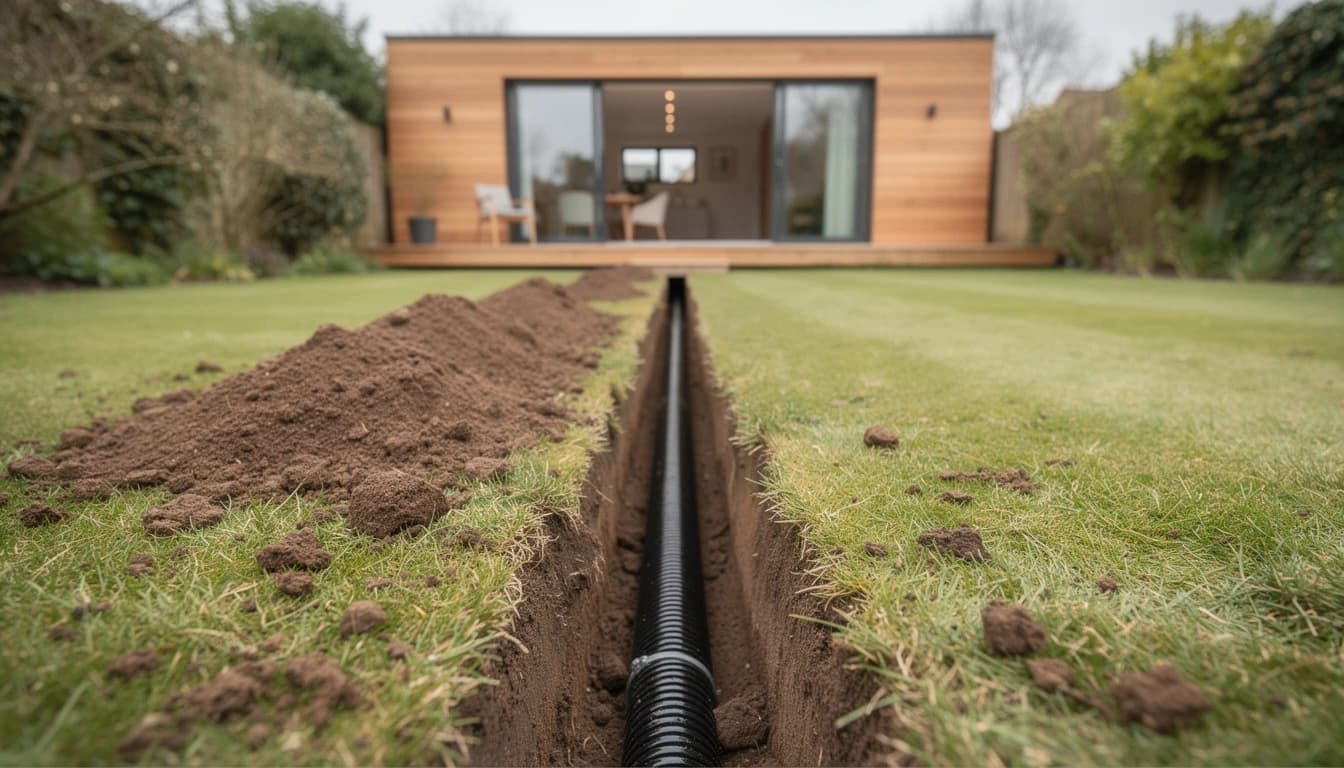
A garden building needs its own circuit run from your consumer unit in steel wire armoured cable, buried at a safe depth, terminating in a small distribution board inside the building. That's the job. An extension lead trailing across the lawn is not a supply, and it's the single most common thing we get called out to replace after something has gone wrong.
Garden offices went from novelty to normal over the last few years, and a lot of them were powered in a hurry. Here's what doing it properly involves, from cable to certificate.
Why the extension lead has to go
Electrical Safety First's garden safety guidance is direct about it: use only "extension leads, cables, and connectors suitable for outdoor use", always "use a residual current device (RCD) with all outdoor electrical equipment", and avoid "digging in the garden close to electric cables, gas pipes, or water services".
A lead run out through a window fails on most of those counts. It sits in the wet, it gets driven over by a mower, the connection point isn't protected, and it's usually feeding far more than it was designed for once a heater goes on in January. Add a laptop, a monitor, a fan heater and a kettle, and a 13A lead is doing work it was never rated for, at the end of a run long enough to drop meaningful voltage.
The other issue is nobody plans for it. The lead is temporary for six weeks, then it's still there four winters later, buried under leaves and gradually perishing.
What a proper supply looks like
Five components, and each one earns its place.
- A dedicated circuit from your main consumer unit, on its own breaker, sized for what the building will actually draw.
- Steel wire armoured cable, commonly 6mm² or 10mm² three core, chosen for the load and the length of the run.
- A buried route, or a properly supported overhead or clipped route where digging isn't practical.
- A small consumer unit inside the outbuilding, giving you separate ways for sockets and lighting, with RCD protection.
- Certification and testing, because this is a new circuit and it's notifiable work.
The sub-board is the part people try to skip, and it's what makes the difference between a garden office and a shed with a socket in it. It means a fault out there trips a device out there, rather than knocking out half the house while you're on a call.
Sizing it for what you'll really use
Be honest about the heating. That's what drives the number.
- Home office, lighting and IT only: genuinely light load, but you'll still want capacity for a heater.
- Office with electric heating: a 2kW panel heater or a small air conditioning unit changes the sizing considerably.
- Workshop with power tools: plan for motor starting currents, which briefly draw well above the running load.
- Garage with an EV charger: a different conversation entirely, because a 7.4kW charge point needs its own capacity assessment against the whole property.
That last one matters more each year. If there's any chance of a charge point going in the garage later, size the supply for it now. Digging the trench twice is the expensive way to find that out, and our EV charger installation service covers what the whole-property assessment involves.
Worth thinking about data at the same time. If you're working out there, a hardwired network cable in the same trench beats fighting with wifi through two brick walls, and running data cabling while the ground is open costs very little extra.
Burying the cable
Armoured cable is buried deep enough that normal garden activity can't reach it, typically at least 450mm in a lawn or border and deeper under a drive. Warning tape goes in above it so the next person with a spade gets a hint before they get a surprise.
Practical points from doing these across London gardens:
- Route it along a boundary or a path edge rather than diagonally across the middle. Future you will want to plant something.
- Keep separation from other services. Water, gas and drainage all need clearance, and crossing them needs care.
- Record the route. Photograph the open trench with a tape measure in shot before it's backfilled. It takes a minute and saves an afternoon in five years.
- Ducting is cheap. Laying a spare duct alongside the cable makes any future addition trivial.
Where the ground can't be dug, because of tree roots, a listed boundary or a solid concrete yard, the cable can be clipped along a wall or run overhead on a catenary. Both are legitimate, both need the right fixings and heights, and neither should involve cable tied to a fence panel.
The earthing catch nobody mentions
Here's the technical wrinkle that decides part of the design. Most London properties are on a PME supply, where the earth is derived from the incoming supply neutral. There are restrictions on extending that earth to outbuildings and to anything where someone might be in contact with true earth, standing on wet grass with a metal-cased tool, for instance.
Depending on the building and what's in it, the outbuilding may need its own earth electrode and a TT arrangement rather than borrowing the house earth. That's set out in BS 7671, the wiring regulations published by the IET, and it's a genuine design decision rather than a formality.
It also affects your main house. Extending a supply outdoors is a good moment to check the main bonding is present and correctly sized, which our post on earthing and bonding covers in detail.
Planning permission and building regulations
Two separate questions and people merge them.
Planning permission concerns the building itself, not the electrics. Many garden buildings fall under permitted development, with limits on height, position relative to boundaries and how much of the garden is covered. The Planning Portal's outbuildings guidance sets out the conditions, and conservation areas and listed buildings have tighter rules. Large parts of inner London sit in conservation areas, so check rather than assume.
Building regulations cover the electrical installation. Installing a new circuit in England is notifiable work, and the government's guidance on building regulations approval confirms you don't need a separate application where the work is carried out by someone registered with a competent person scheme.
You want that certificate. It matters when you sell, when you insure the contents of an office you work from, and on any future inspection.
What it costs
Typical UK market ranges, not our prices, because trench length and ground conditions drive everything.
- Short run, soft ground, small board in the building: around £700 to £1,200.
- Longer run, 15 to 25 metres, with lighting and several sockets fitted out: £1,200 to £2,000.
- Crossing a driveway or patio, with reinstatement: add £300 to £800 depending on the surface.
- Adding an outdoor socket and lighting on the way, covered in our guide to outdoor sockets and garden lighting: usually a modest addition once the trench is open.
Digging is the variable. A clear lawn is a morning. A garden with mature roots, a patio and a raised bed in the way is a different job, and any electrician who quotes it without walking the route is guessing.
Frequently asked questions
Can I run a supply to my shed myself?
Installing a new circuit is notifiable work under the Building Regulations in England, so it needs certifying either by a registered electrician or through building control. Beyond the paperwork, cable sizing, burial depth and the earthing arrangement all need calculating, not estimating.
How deep does armoured cable need to be buried?
At least 450mm under a lawn or planting is the usual working figure, deeper under a driveway or anywhere likely to be dug. Warning tape sits above the cable so anyone excavating later finds it before the spade does.
Can I use ordinary twin and earth in a plastic duct instead?
No. Standard twin and earth isn't suitable for burial even inside a duct, because ducts fill with water and the cable has no mechanical protection. Steel wire armoured cable is what the job needs.
Do I need a consumer unit in the garden office?
For anything with sockets and lighting, yes, and it makes the building far more usable. A small two or three way board with RCD protection lets you isolate faults locally instead of tripping the house.
Will a garden office supply affect my main consumer unit?
It needs a spare way and adequate capacity. Older boards are often full or lack RCD protection, in which case a board upgrade gets bundled into the job. Better to know that at quote stage than on the day.
Can I put an EV charger in a detached garage?
Usually yes, but it needs assessing against your incoming supply capacity and the earthing arrangement, not just the garage circuit. It's also the reason to oversize the armoured cable now rather than later.
Planning a garden room or finally sorting out the shed? See our sockets and outdoor power service or call 020 3653 2600. We'll walk the route with you, tell you honestly what the ground is going to cost you, and quote it fixed.
Related reading
Electric Shower Installation: Cost, Circuits and the Catch
What an electric shower install actually involves in a London home, why the consumer unit decides half the price, and the questions to ask before you book.
Read more
Does an Electric Cooker Need Its Own Circuit?
Most electric cookers and every electric hob need a dedicated circuit. Here is how to work out whether yours does, and what a proper cooker circuit involves.
Read more
Bathroom Extractor Fan Regulations: Zones, Ventilation and the Rules
What UK law actually requires for bathroom extractor fans: Part F ventilation rates, Part P notifiable wiring, and the BS 7671 zones and IP ratings that decide what goes where.
Read more