
Kitchen Under Cabinet Lighting: Types, Wiring and the Rules
LED strip, linkable bars or pucks? How to pick the right white for food prep, where the power and driver go, what to fit near the sink and hob, and when Part P applies.

By Yousif Imari
Senior Engineer•26 October 2026
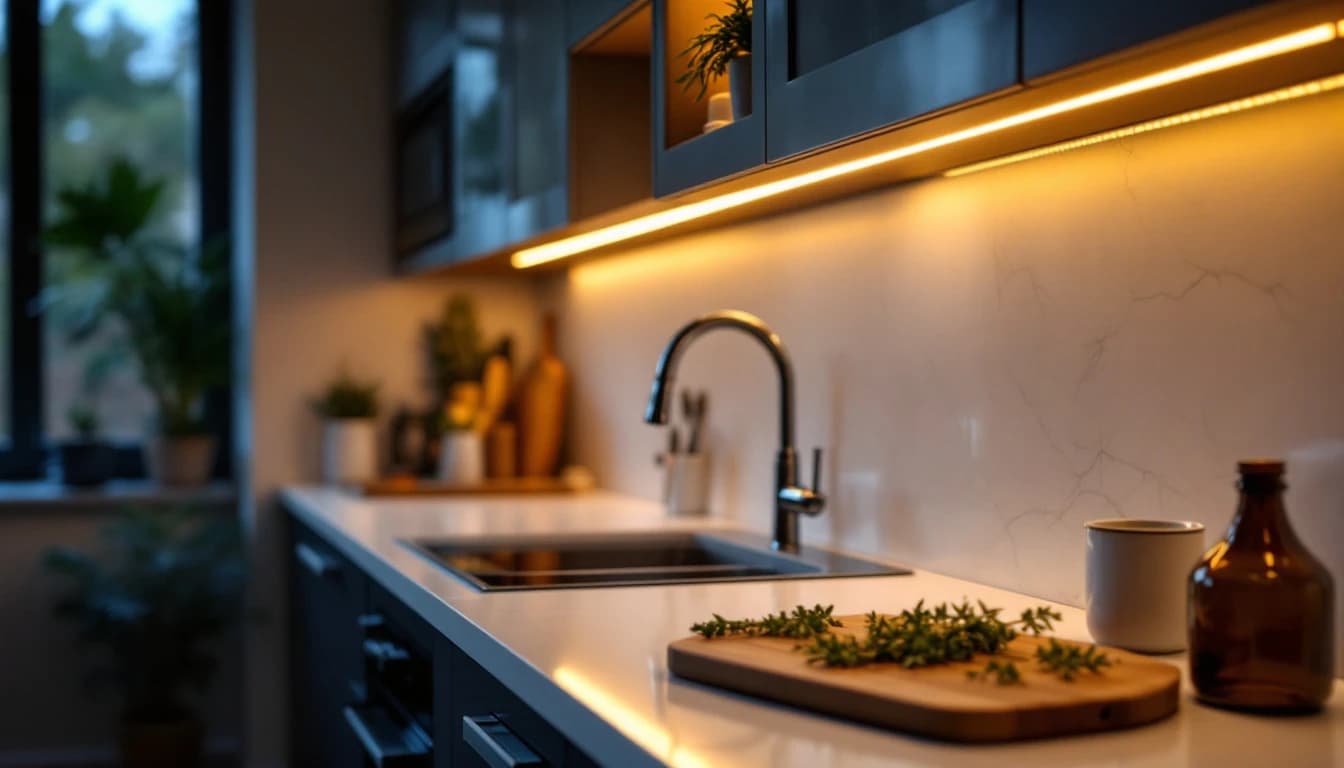
The best kitchen under cabinet lighting for most homes is LED, fitted towards the front of the wall units and hard-wired to a switch or sensor, so there's no plug or trailing lead. Pick strip in a profile for an even line of light, or pucks for pools of light, in natural white (4000K) with a CRI of 90 or higher.
Plug-in and battery kits work too, they just rarely look as tidy.
LED strip, linkable bars or pucks?
All three light the worktop. The difference is the look, and how much wiring sits behind it. Here's one real product of each type, from the makers' spec sheets:
- LED strip (Sensio Neutron): 24V, 4.8W per metre, cut marks every 25mm, IP20, runs from a separate driver
- Linkable bar (Integral LED under cabinet batten, 2ft): mains voltage (220V to 240V) with the driver built in, 9W, 1,080 lumens, CRI 80, IP20
- Puck (Sensio Apex TrioTone): 24V, 1.55W and 100 lumens each, surface mounted or recessed, IP20
Sources: manufacturer specifications for Sensio Neutron, the Integral LED under cabinet batten and Sensio Apex TrioTone.
LED strip
Strip gives you one continuous line of light, which Sensio's under cabinet guide says means an even wash along the worktop with fewer shadows between lights. It can be cut to suit each cabinet, so odd-sized units aren't a problem. We fit it in an aluminium profile, because bare strip over a polished worktop reflects back as a row of bright dots. Tightly packed LEDs help as well: Sensio says Neutron's "highly compacted diodes greatly reduce the appearance of dots", and it carries 280 of them per metre.
Linkable bars
Linkable bars are rigid fittings in set lengths that join up with link accessories. Integral's batten comes in 1ft to 5ft lengths, and the maker says runs can be linked "without the need for more wiring". The 2ft version runs on mains voltage with its driver built in, so there's no separate box to hide. The catch is those fixed lengths. If your units are odd widths, you get gaps where a strip would have run edge to edge.
Pucks
Pucks, or under cabinet spotlights, give pools of light and a more classic look. Sensio's advice is to space them evenly so the pools meet. They can sit on the surface or be recessed into the cabinet base.
Whichever you choose, the position matters more than the fitting. Sensio says to fit lights towards the front of the cabinet underside, so the light falls on the front of the worktop where you work, not only on the wall behind. Mount them at the back and you'll be chopping in your own shadow.
Colour temperature and CRI for food prep
Colour temperature, measured in kelvin (K), is how warm or cool the white looks. Sensio calls natural white (4000K) a popular choice for worktops because it's "clear without feeling cold", and its worktop guide matches the white to the material:
- Wood worktops: warm white, 2700K to 3000K
- Marble worktops: neutral white, 3500K to 4500K
- Concrete worktops: cool white, 5000K to 6500K
- Colour rendering (CRI) where colour accuracy matters: 80 as a minimum
- A strong specification for most kitchens: 4000K with a CRI of 90 or more
Sources: Sensio, light temperatures for kitchen worktops and Sensio, CRI explained.
CRI is the number most people skip. It's a 0 to 100 scale of how faithfully a light shows colours compared with daylight, which scores 100. Sensio's example is meat that looks better in the supermarket than under your kitchen spotlights, and its point is that with a higher CRI, fresh produce and worktop materials read more accurately. So check the spec sheet before you buy. The Integral batten above is CRI 80, which meets the minimum but falls short of the 90 plus Sensio suggests for kitchens.
Match the under cabinet white to your ceiling lights, too. A 4000K strip under 3000K downlights looks like two different kitchens stitched together. If you're choosing both at once, our guide to the best downlights for a kitchen covers the ceiling side. Selectable fittings help: Integral says its batten's colour temperature can be changed "both during and after installation".
Plug-in, battery or hard-wired?
- Plug-in: a plug-in driver goes into a worktop socket. Sensio's Modus is a 30W, 24V driver that plugs into a standard UK socket, so lights can be added without new mains wiring.
- Battery: rechargeable stick-on bars. No wiring at all, but you'll be recharging them, and they suit the inside of a cupboard better than a worktop.
- Hard-wired: the driver is connected to the mains and the lights work from a wall switch or a sensor. Sensio says that mains connection should be made by a qualified electrician.
Source for the plug-in and hard-wired details: Sensio, how to choose an LED driver.
Hard-wired looks tidiest because nothing shows. The driver sits out of sight on top of a wall unit and the cables run through the cabinets, so there's no lead dropping down the splashback to the socket you wanted for the kettle. It's also the option that can switch with the rest of your kitchen lights. Hard-wiring under cabinet lights is part of our lighting installation service.
Where the power comes from
On a hard-wired job there are two usual routes, and the choice comes down to how you want to switch the lights.
From the lighting circuit. The lights then work from a wall switch, either their own or shared with the ceiling lights. Dimming needs the right driver. Sensio's Titan Dimmable works with a mains wall dimmer from 5% to 100%, while its Titan+ and smart drivers "must not be used with a wall dimmer" and dim through sensors or an app instead.
From a fused spur. A fused connection unit taken off the kitchen socket circuit, with a small fuse to suit the driver and often its own switch above the worktop. This suits sensor control, where the lights stay powered and the sensor does the switching. Sensio's leader and follower sets, for example, put an infrared sensor on one light that controls the whole run, so you switch everything with a wave of the hand.
The driver turns mains power into the 24V the lights run on. Sensio's rule is to add up the wattage of everything on it and choose a driver rated higher than that total. Its Titan drivers are 16mm deep, so they fit behind kickboards and above wall units. Wherever it goes, we put it somewhere we can get back to later, never sealed behind a panel.
Driver size and running cost, worked through
- Strip: 3 metres of Neutron x 4.8W per metre = 14.4W
- Driver: rated above 14.4W
- Use: 4 hours a day, so 14.4W x 4 = 57.6Wh, or 0.0576kWh
- Cost per day: 0.0576kWh x 26.32p = 1.5p
- Cost from 1 October to 31 December (92 days): 0.0576kWh x 92 = 5.3kWh, x 26.32p = £1.39
Sources: Sensio driver guide, Sensio Neutron specification and Ofgem energy price cap unit rates, 1 October to 31 December 2026 (26.32p per kWh, Direct Debit average). The sum leaves out the small amount the driver itself uses.
Heat, steam, the sink and the hob
Most under cabinet fittings are IP20. Sensio describes IP20 as protected against solid objects over 12mm, like fingers, and says it's "for dry areas such as kitchens, bedrooms and wardrobes". So a normal run under the wall units is fine. The exceptions are the spots near water and heat.
- IP20: protected against solid objects over 12mm, for dry areas
- IP65: dust-tight and protected from water jets in any direction, and what Sensio says to look for where lights are exposed to water
- Maximum operating temperature: 45°C on Integral's linkable batten, a figure worth checking on anything near the hob
- Switches near the sink: at least 30cm away horizontally, where possible
Sources: Sensio Sigma 2 specification, Sensio under cabinet guide, Zehnder for the IP65 definition, the Integral LED specification and Electrical Safety First kitchen advice.
In practice, if a wall unit spans the sink, that's the stretch for an IP65 product. Where the hob sits under a cooker hood with its own lights, we stop the run either side and keep the driver well away. And don't park the kettle under a fitting, because steam rising into an IP20 light every morning is the condition it isn't built for. The 30cm figure for switches is Electrical Safety First's advice, and our post on kitchen socket regulations explains why there's no legal minimum.
Does the work need certifying?
Kitchens in England aren't a special location under Part P. In Approved Document P, special locations are the space around a bath or shower, plus rooms with a swimming pool or sauna heater. So for under cabinet lighting, it mostly comes down to whether there's a new circuit.
- Lights added to an existing lighting or socket circuit: not notifiable
- A new circuit from the consumer unit for the lights: notifiable
- Plug-together kitchen lighting systems: still within the scope of Part P, but notifiable only if the job includes notifiable work
- A new consumer unit as part of a kitchen refit: notifiable
Source: Approved Document P, 2013 edition, on gov.uk.
Not notifiable isn't the same as no paperwork. Approved Document P says non-notifiable work should still be inspected, tested and certificated to BS 7671 (the IET Wiring Regulations), and local authorities can take enforcement action if they find it unsafe. Ask for a certificate either way.
If you're having a whole new kitchen, plan the under cabinet feed before the splashback and wall units go up, because running a cable afterwards means disturbing things you've just paid for. If the ceiling is being redone too, our LED spotlights and downlights work can be planned at the same time.
Frequently asked questions
What is the best under cabinet lighting for a kitchen?
For most kitchens, LED strip in an aluminium profile or a run of evenly spaced pucks, fitted towards the front of the wall units and hard-wired to a switch or sensor. Go for 4000K and a CRI of 90 or more so food and worktops look true.
What colour temperature is best for under cabinet lights?
Natural white, around 4000K, suits most worktops. Warm white (2700K to 3000K) flatters wood, and cool white (5000K to 6500K) suits concrete. Whatever you choose, match it to your ceiling lights.
Can under cabinet lights be plugged in?
Yes. A plug-in driver goes into a standard socket, so no new wiring is needed. The trade-off is a visible lead and one fewer socket on the worktop.
Do I need an electrician to fit under cabinet lights?
Sensio says the 24V lights themselves are simple to fit because they plug into the driver, but any mains work, including connecting the driver, should be done by a qualified electrician. If the job needs a new circuit, it's also notifiable under Part P.
Why have my under cabinet lights stopped working?
Check the switch or spur is on and nothing has tripped at the consumer unit. If one light at the end of a run is out, a plug-in connector between lights may have worked loose, so check it with the power off. If the driver is hot or smells of burning, switch off at the consumer unit and call an electrician. Don't open the driver.
Planning a new kitchen, or fed up with chopping in your own shadow? See our lighting installation service or call us on 020 3653 2600 for a straight answer and a fixed quote.
Related reading
Ceiling Fan Installation: Fixing, Wiring and Costs Explained
Swapping a pendant for a ceiling fan is a half day job when the fixing and wiring are right. Here's what a proper ceiling fan installation involves, and what it costs.
Read more
Smart Light Switches and the Missing Neutral Wire
Most UK light switches have no neutral, which is why smart switches fail. Here are the four ways round it and which one suits your house and your lights.
Read more
Outdoor Socket Installation and Garden Lighting: A Safe Guide
Adding an outdoor socket or garden lighting isn't a weekend DIY job. Here's the safe, legal way to do it, from RCDs and IP66 sockets to SWA cable and Part P.
Read more