
Hot Tub Electrical Installation: 13A, 32A and Part P
Plug-and-play 13A or hard-wired 32A? What a hot tub really needs electrically, why extension leads are out, when Part P applies, and what it costs to run at the October 2026 price cap.

By Mo Elm
Lead Engineer•30 October 2026
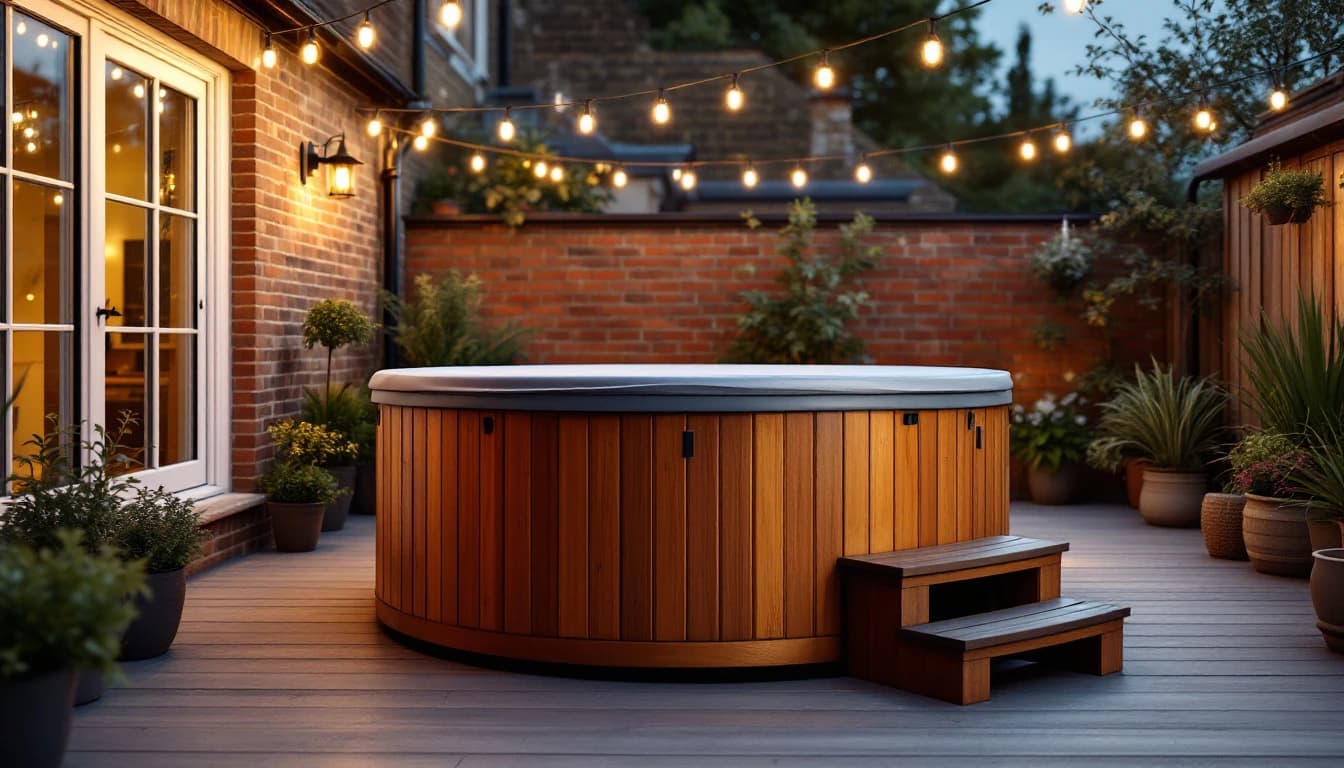
A hot tub needs one of two electrical set-ups. Plug-and-play tubs run from a 13A outdoor socket with RCD protection, placed where the tub's own lead reaches it. Hard-wired tubs need a dedicated 32A circuit from your consumer unit to an isolator near the tub. Neither should ever run from an extension lead.
Hot tubs aren't a niche buy any more. The IET wrote in 2021 that around 25,000 hot tubs and 250,000 portable hot tubs are sold in the UK each year. The wiring they plug into hasn't always kept up. A tub is a long-running load sitting in water, in a garden, with wet people in it, so getting the hot tub electrics right before delivery day matters.
13A plug-and-play or 32A hard-wired: what the makers say
The tub sets the electrical requirement, so start with the manufacturer's spec. Here's how two brands describe it on their UK websites.
- Lay-Z-Spa inflatables: standard UK 13A/240V supply, heater rated 2,000W, a PRCD built into the lead
- Lay-Z-Spa socket position: at least 4 metres from the tub and 1.2 metres off the ground, within reach of the 7-metre lead
- Canadian Spa Company 13A tubs: outdoor-rated 13A socket on an RCD-protected circuit, around 3kW of continuous load
- Canadian Spa Company 32A tubs: dedicated 32A circuit, roughly 7.4kW, with a 3kW heater instead of 2kW
- 32A pumps: 5HP continuous-duty pumps drawing 15.2A each, which the maker says a 13A circuit can't power
- 32A connection: RCD-protected run from the consumer unit to a rotary isolator near the spa, then 6mm armoured cable to the tub
Sources: Lay-Z-Spa FAQ; Canadian Spa Company's 13A plug-and-play and 32A hard-wired range pages.
Two details from those pages are worth knowing before you buy. Canadian Spa Company says most of its hard-shell 13A models can be converted to 32A later, but inflatables are 13A only. It also says that across its range the heater switches off by default when the high-speed pumps run, on 13A and 32A models alike. So 32A doesn't always mean heating and jets at once. It buys bigger pumps and a faster heat-up.
Notice too that Lay-Z-Spa's lead has its own PRCD, yet the company still says to use a socket with RCD protection. A device on the lead can only protect what's downstream of it. The socket and the wiring behind it need their own protection.
Why an extension lead is never the answer
Both manufacturers are blunt. Lay-Z-Spa's FAQ answers "Can I plug my Lay-Z-Spa into an extension lead?" with a flat no, and says the socket must support 2,050W when the heater is on. Canadian Spa Company's checklist rules out extension cables and adapters of any kind.
It comes down to the kind of load. A kettle pulls its full current for a few minutes. A hot tub heater can run for hours on a cold night, outdoors, often through a lead that's been lying in wet grass. Electrical Safety First's extension lead guidance says that if you regularly rely on extension leads, you should consider having extra wall sockets installed by a registered electrician. A tub that runs all season is about as regular as it gets. The general rules on loading and daisy chaining are in our extension lead safety guide.
If the lead won't reach, the fix is a properly placed outdoor socket. Our guide to outdoor sockets and garden lighting shows what a good one looks like.
What a proper hot tub supply looks like
The IET published a Wiring Matters article on hot tub installations after an influx of calls to its helpline. Put that together with the manufacturers' requirements and a proper job looks like this:
- A dedicated circuit: its own way in the consumer unit for a 32A tub, not a spur off the nearest socket.
- 30mA RCD protection of the right type: the IET says to pick the RCD type from the manufacturer's instructions, because the tub's electronics may call for something like a Type A device.
- An isolator near the tub, but not too near: the IET places it outside zone 1, 2 metres from the edge of the water.
- Fixed wiring where possible: the IET calls this best practice, because a socket beside the tub invites misuse.
- Armoured cable with its route recorded: warning tape above any buried run, and Electrical Safety First's Wiring Regulations guidance strongly recommends marking the route on a drawing attached to the Electrical Installation Certificate.
Cable depth and routing work the same way as any garden run, and our guide to running power to a garden office or shed covers them, along with the earthing question.
The IET article makes one point most buyers never hear. The person using a tub is wet and often barefoot on the ground, so the IET argues an outdoor hot tub carries the same shock risk as a swimming pool. IET Guidance Note 7 recommends applying the swimming pool section of BS 7671 (the IET Wiring Regulations) in full to outdoor tubs. That affects what goes nearby: the IET says metal Class I light fittings shouldn't go within 2 metres of the water, and lights belong on a wall or ceiling, not set into the deck around the tub.
It also raises earthing. On a PME supply, the IET points out that an RCD won't operate if the supply's combined neutral and earth conductor breaks, which is why some designers give the tub a separate TT earth. That's a judgement made on site, and it's one reason a hot tub circuit isn't a quick add-on.
Is hot tub electrical work notifiable under Part P?
For a hard-wired tub, yes. Approved Document P makes installing a new circuit notifiable in England, and a dedicated 32A hot tub circuit is exactly that. Replacing the consumer unit to make room is notifiable as well.
A new outdoor socket for a 13A tub is different. Added to an existing circuit, it's an addition outside a special location, which Approved Document P lists as non-notifiable. The same document still says non-notifiable work should be tested and certificated to BS 7671, just like notifiable work. It also confirms that fixed equipment falls within Part P even when the final connection is a 13A plug.
A registered electrician can self-certify notifiable work, so there's no separate application to building control. Our Part P explainer covers how that works.
Is there room in your consumer unit, and in your supply?
Two questions decide whether a 32A tub is a half-day job or a bigger one.
First, the consumer unit. The new circuit needs a spare way and suitable RCD protection. Canadian Spa Company tells its buyers that new-builds and recent renovations almost always have spare ways, and that full boards are common on 1990s and older units. If yours is full, or lacks proper RCD protection, a consumer unit upgrade comes first, and it's far easier to sort before the tub arrives than after.
Second, the supply into the house. A 32A circuit is a big slice of a 60A main fuse before anyone has boiled a kettle or plugged in a car, so your electrician should work out the maximum demand. If the numbers don't work, your network operator can upgrade the main fuse. In London that's UK Power Networks.
- Upgrades from: a 30A or 60A main fuse
- Upgrades to: an 80A or 100A main fuse
- Before the visit: your meter, meter tails, fuse board and consumer tails must be the right size for the extra load
- Site visit: free to request, and UKPN aims to contact you within 10 working days
- Possible charges: if your supply is shared with a neighbour or the incoming cable needs upgrading
- Above 100A: you may need a full supply upgrade instead
Source: UK Power Networks, fuse upgrade.
What a hot tub costs to run: a worked example
From 1 October to 31 December 2026, the Ofgem price cap puts the average electricity unit rate at 26.32p per kWh for Direct Debit customers, as an average across Great Britain, with no VAT on electricity. Using that rate and the wattages the manufacturers publish:
- 2kW heater (Lay-Z-Spa), one hour: 2 kWh x 26.32p = about 53p
- 3kW heater (Canadian Spa Company 32A), one hour: 3 kWh x 26.32p = about 79p
- 800W massage pump (Lay-Z-Spa), one hour: 0.8 kWh x 26.32p = about 21p
- 50W filter pump (Lay-Z-Spa), 24 hours: 1.2 kWh x 26.32p = about 32p a day
- First heat-up, 2kW inflatable, 12°C to 38°C: 13 to 17 hours, 26 to 35 kWh, roughly £6.84 to £9.12
Sources: Ofgem energy price cap, 1 October to 31 December 2026; Lay-Z-Spa FAQ; Canadian Spa Company 13A and 32A range pages.
The heat-up line uses Lay-Z-Spa's own figure of about 1.5 to 2°C an hour, and Canadian Spa Company's note that mains water comes in at 10 to 14°C, so we've taken 12°C. In cold weather it takes longer, because the heater is fighting heat loss too.
The makers' own estimates are a useful sense check. Lay-Z-Spa's weekly running costs range from £3.50 to £12 depending on model and cover, worked out at 24.67p per kWh, so add roughly 7% at the current cap. Canadian Spa Company says even its 6-seat 32A tubs cost about £2 to £2.50 a day to run. At 26.32p that's 7.6 to 9.5 kWh a day, roughly its 3kW heater running for two and a half to three hours.
So the heater's wattage sets the cost per hour, but the cover and the weather set the number of hours. Canadian Spa Company says 32A doesn't buy cheaper daily running, while Lay-Z-Spa's weekly figure for its regular inflatable drops from £9 to £12 to £6 to £8 with a thermal cover and floor mat.
Frequently asked questions
Can I plug a hot tub into a normal socket?
Only a 13A plug-and-play model, and only into an outdoor-rated socket with RCD protection, placed where the manufacturer says. Lay-Z-Spa wants it at least 4 metres from the tub and 1.2 metres off the ground. A 32A tub is hard-wired to its own circuit instead.
Does a hot tub need its own circuit?
A 32A tub does. A 13A tub can run from a suitable outdoor socket, though Lay-Z-Spa recommends nothing else runs from that socket at the same time.
Can I use an extension lead for a hot tub?
No. Lay-Z-Spa says extension cables can't be used with its tubs, and Canadian Spa Company says the same for its plug-and-play range. If the lead won't reach, have an outdoor socket fitted where it will.
Do I need building regulations approval for a hot tub?
A new circuit is notifiable under Part P, so a hard-wired tub's supply has to be certified, usually by a registered electrician who self-certifies. A socket added to an existing circuit isn't notifiable but still has to be tested and certificated to BS 7671.
How much does it cost to run a hot tub per hour?
At the October to December 2026 cap of 26.32p per kWh, a 2kW heater costs about 53p an hour and a 3kW heater about 79p. Insulation and the weather decide how many hours a day it runs.
Should I check a second-hand hot tub for recalls?
Yes. Electrical Safety First's recall list includes 3kW versions of several Jacuzzi models, where the main circuit board may overheat and catch fire. If yours is listed, ESF says stop using it and contact the retailer.
Planning a hot tub anywhere in London? See our consumer unit upgrade service or call us on 020 3653 2600 for a straight answer and a fixed quote before the tub arrives. If it's easier, send us the tub's spec first.
Related reading

Electric Towel Rail: Running Costs, Wiring and the Rules
Electric-only or dual fuel, what an electric towel rail really costs to run at Ofgem's 26.32p unit rate, and how it should be wired into a bathroom safely and legally.
Read more
Electric Underfloor Heating: Running Costs and the Wiring Side
Mats, loose cable or foil, what each costs to run on the October 2026 price cap, and the electrical side most guides skip: amps, circuits, RCDs, probes and Part P.
Read more
Ring Main vs Radial Circuit: What's Behind Your Sockets
How a ring main and a radial circuit actually work, how many sockets a ring can take, why kitchens often get their own radial, and the ring faults an EICR picks up.
Read more