
Electric Towel Rail: Running Costs, Wiring and the Rules
Electric-only or dual fuel, what an electric towel rail really costs to run at Ofgem's 26.32p unit rate, and how it should be wired into a bathroom safely and legally.

By Yousif Imari
Senior Engineer•23 October 2026
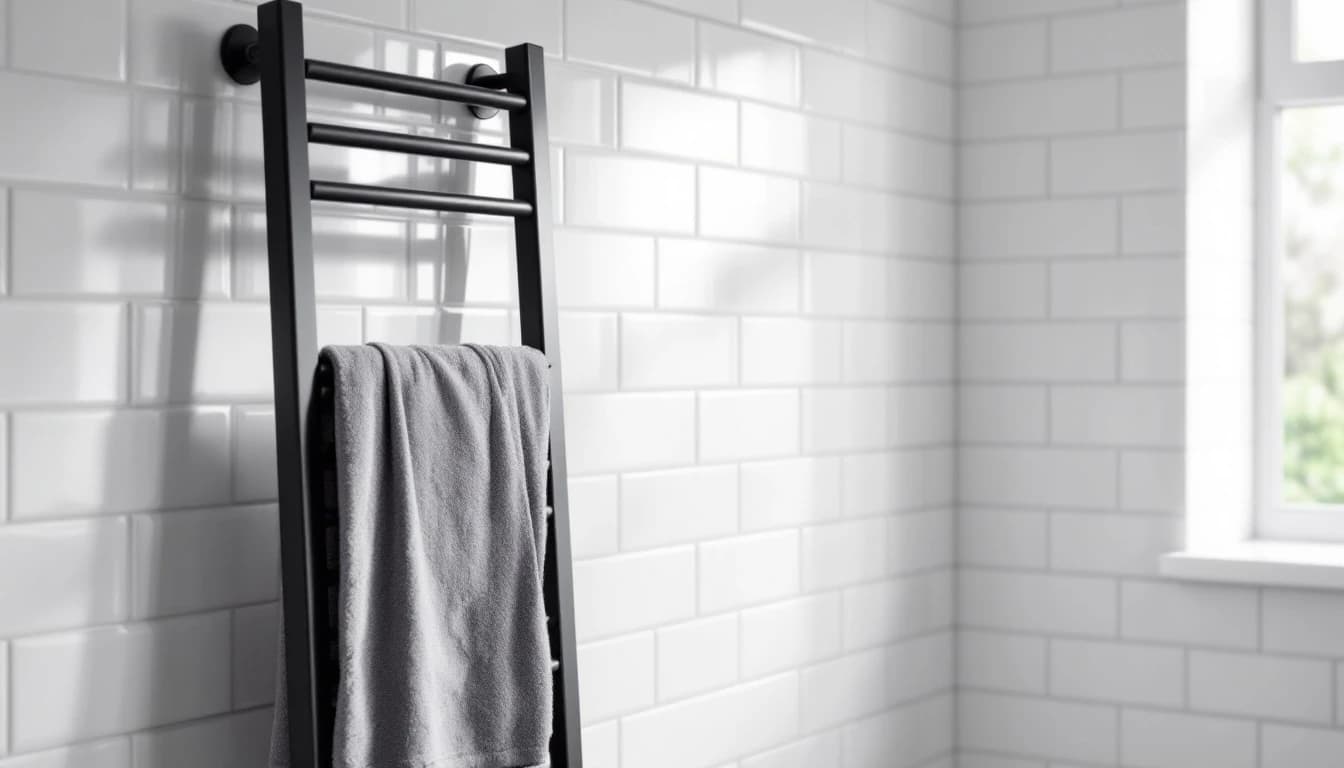
An electric towel rail heats your towels with an electric element, either on its own (electric-only) or alongside your central heating (dual fuel). A 300W rail on a two-hour timer costs about 16p a day at Ofgem's October to December 2026 rate. In a bathroom it should be hard-wired through a switched fused spur, not plugged in.
We've worked the running costs out line by line below, so you can redo them for your own rail and tariff.
Electric-only or dual fuel?
An electric-only rail has no connection to your boiler. It's filled with a carefully measured amount of liquid, which the element heats, and that fluid isn't something you top up yourself. Terma's heating element manual says to contact your supplier if a rail ever loses its heating medium.
A dual fuel rail is plumbed into your central heating like any other radiator, with an electric element added for when the boiler is off. Zehnder pitches its dual fuel option at exactly that, warmth "during the summer months when the central heating system is not in use", and supplies its thermostatic element with a matching T-piece.
- Electric-only: needs an electrical connection and nothing else, so it can go where there are no heating pipes.
- Dual fuel: needs a plumber for the heating side and an electrician for the element.
- Pressure in an electric-only rail: an air cushion is kept inside so the liquid has room to expand.
- Valves on a dual fuel rail: one valve must stay open, for the same reason.
- Element size on a dual fuel rail: no bigger than the rail's own rated heat output.
Sources: Terma heating element user manual and Zehnder heated towel rails.
Make sure everyone at home knows the valve rule. And if the rail is a new addition to your heating, not a swap for an old radiator, gov.uk lists adding extra radiators to a heating system among the jobs that might need building regulations approval, so ask your plumber how they'll handle it.
Our rule of thumb: already got a radiator on the heating there? Go dual fuel. No heating pipes in the bathroom? Electric-only saves a plumbing job.
How big a rail, and how many watts?
Element wattage follows the size of the rail. Stelrad says to match the element to the rail's surface area and pick one rated just below what the rail can handle, because an element that's too powerful can trip the rail's built-in thermal fuse. Too small, and the rail never gets properly warm.
- 600 x 600mm rail: a 300W to 500W element, as a rough guide
- 1800 x 600mm rail: a 600W to 1,000W element
- A rail that also heats the room: size it with a BTU calculator based on the room itself
- Element outputs on one maker's range (Terma MOA): 120W, 200W, 300W, 400W, 600W, 800W, 1,000W and 1,200W
Sources: Stelrad heating element sizing guide and Terma MOA technical parameters.
Even a 1,200W element only draws about 5.2 amps (1,200 divided by 230 volts), so a towel rail usually runs off an existing circuit through a fused spur, provided that circuit has the capacity and the right protection.
What an electric towel rail costs to run
Watts divided by 1,000, times the hours it's on, gives you kilowatt hours (kWh). Multiply that by your unit rate. From 1 October to 31 December 2026, the average price cap rate for electricity is 26.32p per kWh for people paying by Direct Debit, and Ofgem notes there's no VAT on electricity from 1 October 2026 to 31 March 2027.
300W rail on a two-hour timer
- Element: 300W = 0.3kW
- Energy per day: 0.3kW x 2 hours = 0.6kWh
- Cost per day: 0.6kWh x 26.32p = 15.8p
- Cost from 1 October to 31 December (92 days): 0.6kWh x 92 = 55.2kWh, x 26.32p = £14.53
The same 300W rail left on day and night
- Energy per day: 0.3kW x 24 hours = 7.2kWh
- Cost per day: 7.2kWh x 26.32p = £1.90
- Cost over the 92 days: 662.4kWh x 26.32p = £174.34
Source: Ofgem energy price cap unit rates, 1 October to 31 December 2026. Rates differ by region and by how you pay, so swap in the unit rate from your own bill.
A 600W rail doubles every figure: 31.6p a day on the timer, £29.06 over the quarter. Treat all of them as a ceiling, because they assume the element runs flat out every minute it's on, and a thermostatic element switches itself off once the rail is up to temperature. Compare the two examples and you can see where the money goes: hours left switched on.
Why a plug-in rail doesn't belong in a bathroom
Some makers sell the same element with or without a plug. The sticking point is the socket. NICEIC and Electrical Safety First both say ordinary sockets are only allowed in a bathroom at least 2.5 metres from the edge of the bath or shower tray, shaver supply units aside. As NICEIC puts it, unless you have a sizeable bathroom, you won't be able to fit a socket at all.
The usual workaround, an extension lead run in from the landing, is exactly what Electrical Safety First warns against. Terma's manual also rules out extension leads and plug adapters, and only allows its plug-in versions outside zone 2. And Approved Document P says fixed equipment is within the scope of Part P even if the final connection is a standard 13A plug. Outside the bathroom, a plug-in rail can be perfectly sensible, as long as it isn't fitted directly underneath a socket, which Terma also rules out.
Electric towel rail installation: how it's usually wired
This is the job we do under appliance installation, and what matters is where each part goes.
- The supply. A feed from a suitable existing circuit, or a new one, with RCD protection. Electrical Safety First says all circuits in or passing through bathrooms now need an RCD, and Terma's manual asks for a 30mA RCD.
- The switched fused spur. This sits outside zones 0, 1 and 2, often on the landing just outside the bathroom door. NICEIC notes that even in zone 2, only SELV switches and sockets (plus compliant shaver sockets) are allowed, so a mains switch has no place there. Terma also wants a switch that disconnects all poles with a contact gap of at least 3mm, so the spur we fit is double-pole.
- The connection at the rail. A cable runs from the spur to a flex outlet plate beside the rail, and the element's lead connects there. No plug, and nothing to pull out with wet hands.
Our guide to fused spurs and fuse sizes explains how the fuse is matched to the rail's wattage. Terma's safety guidance also says to fit the rail with its lowest bar at least 600mm off the floor, away from very small children. If the spur needs moving out of the zones during a refit, that's part of our sockets and switches work.
IP ratings by zone
- Zone 0, inside the bath or shower tray: IPX7 and a SELV supply of no more than 12V AC, so a mains towel rail is out
- Zone 1, above the bath or tray up to 2.25m (or the shower head if higher): IPX4 or IPX5, and only equipment the manufacturer confirms is designed for zone 1
- Zone 2, 600mm beyond zone 1: IPX4 or IPX5
- Outside the zones: no specific water rating, though splash-proof is still recommended
- Usual minimum for a bathroom appliance: IP44
Source: NICEIC, bathrooms and electrics. For where each zone starts and stops in your room, see our guide to bathroom electrical zones.
Check the element's own rating too. Terma's MOA element is IPX5, its MEG is IPX4.
When the job is notifiable under Part P
Under Approved Document P, notifiable work in a home in England means a new circuit, a replacement consumer unit, or any addition or alteration to existing circuits in a special location. In a bathroom, that special location is the space from the floor up to 2.25 metres (or the shower head if higher), reaching 0.6 metres out from the edge of the bath or shower tray. With no tray, it runs 1.2 metres from the shower head.
- New circuit from the consumer unit for the rail: notifiable
- Spur from an existing circuit, rail inside that 0.6m space: notifiable
- Spur from an existing circuit, everything outside that space: not notifiable
- Swapping an old rail for a new one on the same connection: not notifiable, because replacements and repairs aren't
Source: Approved Document P, 2013 edition, on gov.uk.
Not notifiable doesn't mean unchecked. Approved Document P says all electrical work should still be inspected, tested and certificated to BS 7671 (the IET Wiring Regulations). As a NICEIC-registered firm, we self-certify notifiable work, so you never deal with building control yourself, and the compliance certificate reaches you within 30 days.
Timers and thermostatic elements
Stelrad splits elements into two kinds: non-thermostatic ones heat the rail to one fixed temperature, thermostatic ones let you choose.
Terma's MOA is a good example of a thermostatic element. It has five settings from 30°C to 60°C and a two-hour "dryer" boost that drops back to the previous setting afterwards. It also remembers its settings after a power cut, which Terma says makes it suitable for external timers, so a timer on the supply can switch the rail on and off without losing your settings. Any mains timer goes outside the zones, same as the spur.
Safe checks if your rail has gone cold
- Is the spur switched on, and is its neon lit if it has one?
- Has anything tripped at the consumer unit? If it trips again straight after you reset it, leave it off.
- Has the element's timer or temperature setting been turned down?
If you spot scorch marks on the spur or fluid leaking from the rail, switch off at the spur and call an electrician. Don't open the spur or try to turn the element: Terma's manual warns that forcing its cap can break the seal and create a risk of electric shock.
Frequently asked questions
How much does it cost to run an electric towel rail?
At Ofgem's average rate of 26.32p per kWh for 1 October to 31 December 2026, a 300W rail on for two hours a day costs about 15.8p a day, or £14.53 over those 92 days. A 600W rail on the same timer costs double.
Can I plug an electric towel rail into a socket in the bathroom?
In most homes, no. Sockets are only allowed at least 2.5 metres from the edge of the bath or shower tray, and extension leads shouldn't power anything in there. A switched fused spur outside the zones is the standard answer.
Is fitting an electric towel rail notifiable under Part P?
Yes if it needs a new circuit, or if the rail goes within 0.6 metres of the edge of the bath or shower tray. Otherwise no, and a like-for-like swap isn't either. Either way, the work should be tested and certificated.
Can I leave an electric towel rail on all the time?
Decent elements have overheating protection built in (Terma's MOA has double protection), so the bigger issue is cost. Left on round the clock, a 300W rail can use up to 7.2kWh a day, about £1.90 at the current cap rate.
Want a towel rail wired in properly, with the spur outside the zones and the certificate in your hand? See our appliance installation service or call us on 020 3653 2600 for a straight answer and a fixed quote. We cover every London borough.
Related reading
Hot Tub Electrical Installation: 13A, 32A and Part P
Plug-and-play 13A or hard-wired 32A? What a hot tub really needs electrically, why extension leads are out, when Part P applies, and what it costs to run at the October 2026 price cap.
Read more
Electric Underfloor Heating: Running Costs and the Wiring Side
Mats, loose cable or foil, what each costs to run on the October 2026 price cap, and the electrical side most guides skip: amps, circuits, RCDs, probes and Part P.
Read more
Ring Main vs Radial Circuit: What's Behind Your Sockets
How a ring main and a radial circuit actually work, how many sockets a ring can take, why kitchens often get their own radial, and the ring faults an EICR picks up.
Read more