
Extension Lead Safety: 13 Amps, Daisy Chaining and Heaters
An extension lead shares one socket's 13 amps between everything plugged into it. Here's the simple maths, why daisy chaining causes fires, and when you need more sockets instead.

By Yousif Al-Imari
Senior Engineer•6 October 2026
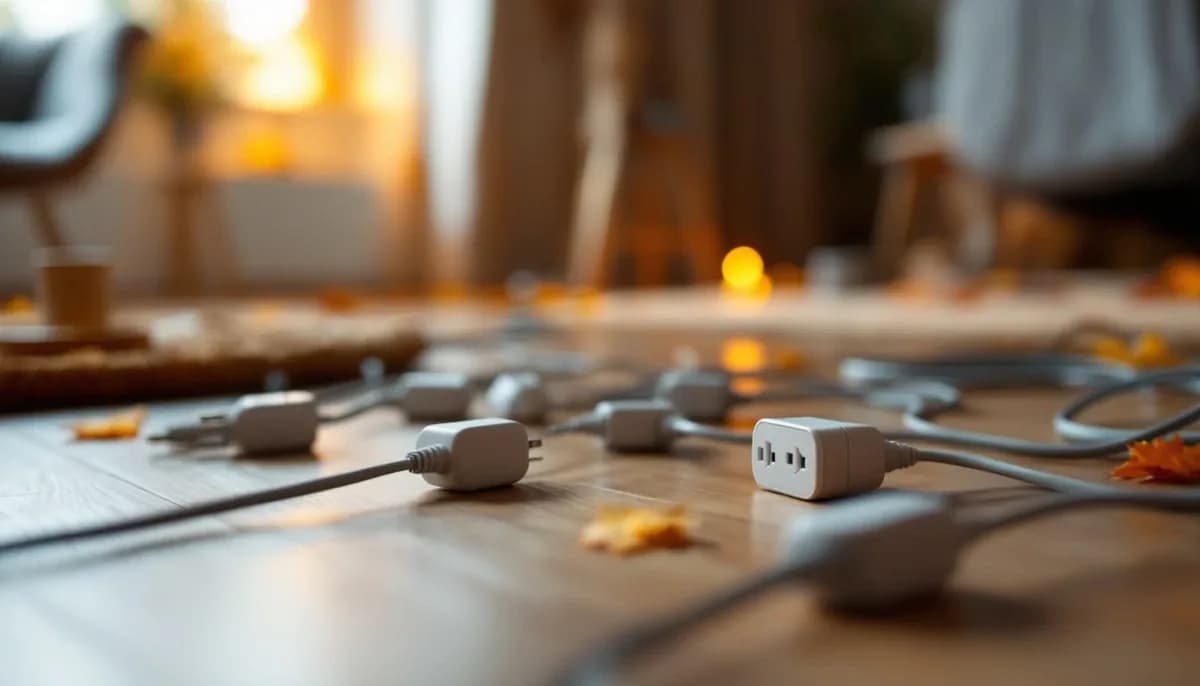
An extension lead does not give you extra power. Everything plugged into it shares the 13 amps of the single wall socket it hangs off, which works out at roughly 3,000 watts in total. That one fact drives the two hard rules of extension lead safety: never plug one extension lead into another, and never run a heater from a lead.
October is when this goes wrong. The first cold week arrives, fan heaters come out of cupboards, and leads that coped all summer suddenly get asked to carry three or four times the load. Every winter we get called to scorched plugs and melted multi-way blocks, and almost every time the owner says the same thing: it had been fine for months. It had, right up until the heater joined in.
The 13 amp rule, and the maths that catches people out
A standard UK socket is fused and rated at 13 amps. At 230 volts that gives you about 2,990 watts to play with, and that budget is shared by everything on the lead. The catch is how quickly common appliances spend it:
- Kettle: 2.5 to 3kW, so 11 to 13 amps on its own. A boiling kettle can use the lead's entire capacity by itself.
- Fan or convector heater: usually 2kW, around 8.7 amps, sometimes 3kW on the highest setting.
- Iron: 2.2 to 2.6kW while it is heating back up.
- Toaster: around 1 to 1.5kW.
- Microwave: roughly 1kW of output, drawing more from the wall.
Check the rating plate on each appliance, because wattages vary. But look at those numbers together. A kettle and a toaster on the same lead is already an overload. A heater plus anything bigger than a phone charger is over too.
And 13 amps is the best case. As Electrical Safety First warns, "most extension leads are rated at 13A but some older ones and many cable reels may be only 10A or less." If your lead is unmarked, ancient, or came free with something, assume less.
If you want to check a setup properly, that same Electrical Safety First page has a socket overload calculator. Put in what you actually plug in and it tells you straight whether you are over. It is worth two minutes of your time before winter.
Can you plug an extension lead into another extension lead?
No. This is daisy chaining, and it is one of the most common causes of overloaded socket fires. Nottinghamshire Fire and Rescue Service is blunt about it: when their investigators look into electrical fires, "frequently the cause of the fire is related to 'daisy chaining'."
Two things go wrong when you chain leads. First, the plug of the first lead now carries the combined load of everything on both leads, and its 13 amp fuse offers no protection against a long, slow overload just under the blow point. Second, every extra plug and socket connection is another point of resistance, and resistance is what turns into heat. Electrical Safety First spells out the result: "overloading can make the extension lead, cable reel, adaptor, or the plug in the wall socket overheat and cause a fire."
The same applies to block adaptors, the chunky cubes that turn one socket into three. One extension device per wall socket is the rule, whether that device is a lead, a reel or a block. If you need more reach, buy one longer lead. If you need more outlets, use a single fused multi-way lead from a reputable retailer. The unbranded blocks and leads that fill online marketplaces are the ones we take straight off jobs and bin.
Cable reels: unwind them fully, every time
A coiled cable cannot shed heat. Run a decent load through a wound reel and the inner loops sit in the warmth of the outer loops, the cable gets hotter, its resistance rises, and it gets hotter still. Electrical Safety First notes that a reel's current rating is "typically as low as 3 or 4A when wound", compared with 10 or 13A fully unwound. So a reel that is fine for a drill can be well past its limit with a 2kW heater plugged into it while still coiled.
Two rules cover it. Unwind the reel completely before you load it, and only buy a reel with a thermal cut-out, the little resettable device that kills the power if the drum overheats. If your reel has no rating marked on it and no cut-out button, replace it rather than trusting it.
Heaters and extension leads: the October problem
Portable heaters are the single worst thing to put on an extension lead, and the reason is plain maths. A 2kW heater is two thirds of a 13A lead's entire capacity before anything else is plugged in, and it draws that continuously for hours rather than for the two minutes a kettle takes.
The fire services see the outcome. Nottinghamshire Fire and Rescue lists "heaters, hair dryers and irons" as the high amperage items that "can easily overload an extension lead", and London Fire Brigade reports that over 160 fires a year are caused by electric heaters, with "a third of electrical fires that ended in a fatality" involving one.
So the winter rules are these. Plug the heater straight into a wall socket, not a lead, not a block adaptor. Keep it at least a metre from bedding, curtains, furniture and you, and never dry clothes on it. And if the only socket is in the wrong corner of the room, that is not a reason to buy a longer lead. It is a sign the room needs another socket.
The two setups we find overloaded most
The home office. A laptop, two monitors, a desk lamp and a printer are all modest loads, and a good quality four-way lead handles them happily. Then November arrives and a fan heater goes into the spare socket on the same lead, and now the lead under your desk is carrying a continuous 10 amps plus everything else, out of sight, often with cables bundled on carpet. The low-draw kit was never the problem. The heater is.
The kitchen. Kettle and toaster sharing a two-way lead behind the bread bin is the classic. Both are high draw, both tend to get used at the same moment at breakfast, and together they blow straight past 13 amps. Kitchen sockets are planned with this in mind, which is why worktop appliances belong in wall sockets. Our post on kitchen socket regulations explains how kitchens are supposed to be laid out.
Signs a lead or socket is in trouble
An overloaded setup usually warns you before it fails. Take any of these seriously:
- A plug that feels warm or hot after the appliance has been running.
- Brown scorch marks or yellowing on the plug, the lead's sockets or the wall socket.
- Buzzing, crackling or tiny sparks when you plug something in.
- A hot plastic or fishy burning smell anywhere near the lead.
- Fuses in plugs blowing repeatedly, or the same breaker tripping.
- Frayed cable, cracked casing, or melted, distorted plastic.
A warm plug is not normal, whatever anyone tells you. Neither is a smell. If you are getting a burning odour from any socket or accessory, switch it off and read our guide to what a burning smell from a socket means before using it again. And never repair a damaged lead with tape. A taped lead has had its day.
These warnings matter because the numbers are not small. London Fire Brigade says it has attended 26,376 electrical fires in London since 2017, and its own advice is to "try to keep to one plug per socket, especially for high powered appliances".
What to look for when buying a lead
- A proper UK 3-pin plug to BS 1363 with a fuse. Every legitimate UK extension lead has one. No fuse, no sale.
- A clear current rating, 13A marked on the lead or its packaging. Unmarked leads are a gamble.
- A decent thickness of flex. A thin cable on a 13A claim is the classic corner cut.
- A thermal cut-out on any cable reel. Non-negotiable on reels.
- A reputable retailer. Electrical Safety First advises avoiding third-party marketplace sellers, where counterfeits and substandard leads circulate. Surge-protected versions are a sensible upgrade for computer and TV setups.
The real fix: sockets where you need them
Extension leads are for temporary use. If the same lead has been in the same place for a year, that is not an extension lead any more, it is a missing socket. Converting a single socket to a double, or adding a new double on the ring where you actually need it, is one of the quickest jobs we do, usually finished in under an hour per socket with minimal mess. Our guide to the cost of adding extra plug sockets breaks down typical prices.
The relief on people's faces when the tangle of leads under the desk or behind the sofa finally goes is genuine. One visit, and the room works the way it always should have. Our socket and switch installation service covers everything from single-to-double conversions to new sockets in home offices and loft rooms.
Frequently asked questions
How many things can you plug into an extension lead?
It is not the number of plugs that matters but the total current. Four phone chargers and a laptop are fine on one lead. One kettle on its own can be the entire 13 amp limit. Add up the wattages on the rating plates and keep the total under about 3,000 watts, or use Electrical Safety First's online socket calculator.
Can you plug an extension lead into another extension lead if both are lightly loaded?
No. Even with modest loads you have added extra connections that heat up, and the first lead's plug still carries everything. The rule has no light-load exception: one extension device per wall socket, always.
Is it safe to run a heater from an extension lead?
No. A 2kW heater uses most of a lead's capacity by itself, for hours at a time, and fire services name heaters as one of the appliances that most easily overload leads. Plug heaters directly into a wall socket.
Can an extension lead actually cause a fire?
Yes, through overloading, daisy chaining, running coiled reels under load, or physical damage. The lead or the plug overheats and ignites whatever is around it. London Fire Brigade has attended more than 26,000 electrical fires in the capital since 2017.
Are block adaptors safe to use?
A good quality, fused block adaptor used on its own in a socket, within the 13 amp total, is acceptable. In practice a fused multi-way extension lead is the better option, because the cheap unbranded blocks sold online often have no fuse at all and sit their weight awkwardly on the socket pins.
Can I use an extension lead permanently?
They are designed for temporary use, and a permanent lead is the tell-tale of a room short on sockets. Adding a double socket where you need it is quick and inexpensive, and it removes the overload risk rather than managing it.
Tired of working around leads, or worried about a setup that is already running hot? See our sockets and switches service or call 020 3653 2600. We will tell you honestly what the room needs and give you a fixed price before we touch a thing.
Related reading
BS 7671 Amendment 3 and the 19th Edition: What Changed
Amendment 3 to BS 7671 took effect on 31 July 2024, Amendment 4 becomes the sole standard on 15 October 2026, and the 19th Edition has no announced date. Here's what any of it means for your home or rental.
Read more
Smoke Alarm Beeping? What the Chirp Means and How to Stop It
A single chirp every 30 to 60 seconds means a low battery or an alarm at the end of its life. Here's how to find the culprit, even on a mains-wired interlinked system.
Read moreEmergency Lighting Testing: What UK Businesses Must Do
The law says maintain it but never says how often. Here's where the monthly and annual tests actually come from, who carries the duty, and what inspectors check.
Read more