
What You Need to Install an EV Charger at Home in London
Off-street parking, board capacity, open-PEN earthing, a DNO notification and a registered installer: what a London home EV charger really needs.

By Yousif Al-Imari
Senior Engineer•17 April 2026
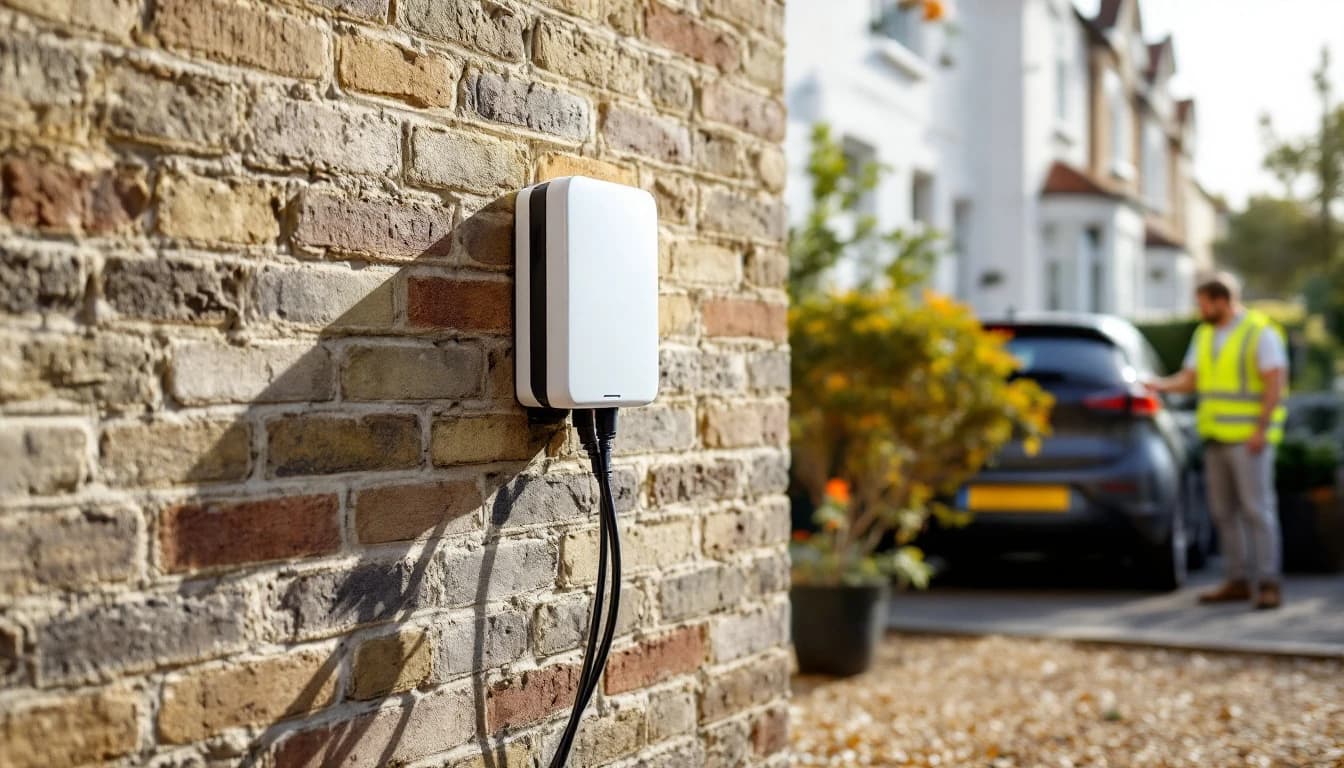
To install an EV charger at home in London you really need five things: somewhere off-street to park and mount the unit, enough spare capacity on your consumer unit (fuse board), the correct earthing arrangement with open-PEN fault protection, notification to your local network operator, and a registered electrician to install and certify it. Get those right and a standard 7kW charger is a half-day job. Miss one and you can end up with a charger that fails its first MOT-style inspection, or a board that trips every time the car plugs in.
We fit EV chargers across every London borough, and most of the headaches we see come from older properties, shared supplies and people assuming a charger is a plug-and-play purchase. It is not. Here is exactly what you need before booking the work.
A place to park and mount the charger
The first requirement is the most physical one. You need off-street parking, a driveway, a garage, a carport or a clearly allocated bay, with a wall or post near it to mount the unit. The cable from a home charger is short and the charger has to sit close to where the car's charging port ends up.
This is where London trips a lot of people up. Plenty of terraces, conversions and flats have no driveway at all, only on-street parking. You cannot legally run a cable across a public pavement on a whim, so a standard wall-mounted charger is off the table unless you have private space.
If you are in a flat or a leasehold property, you also need written permission from the freeholder or managing agent before anyone touches the wall or the supply. We will not start drilling into a communal wall on a tenant's say-so, and neither should any reputable installer. Planning permission is a separate question again, and most home installs are covered by permitted development, which we set out in our guide to whether you need planning permission for an EV charger.
Spare capacity on your consumer unit
A typical home charger draws around 7kW, which on a single-phase supply is roughly 32 amps on its own dedicated circuit. Your existing electrics have to be able to take that on top of the cooker, shower, immersion and everything else, without overloading the main fuse.
Modern boards usually cope fine. The problem is older ones. If you still have a plastic-cased unit with rewireable fuses, or a board with no spare ways and no RCD protection, it almost certainly needs upgrading before a charger goes anywhere near it. That is common in Victorian and Edwardian London housing stock that has never been fully updated, and it often shows up alongside the other signs a house needs rewiring.
A few signs your board is not ready for an EV charger:
- No spare ways: the board is full, with no room for a new dedicated circuit.
- Old technology: rewireable fuses or an old plastic enclosure rather than modern circuit breakers and RCDs.
- It already trips: if it nuisance-trips now, adding a 7kW load will make it worse, not better.
If any of that sounds familiar, read our guide on whether your fuse board is safe first, and budget for a board replacement as part of the project rather than a nasty surprise on the day. Our guide to consumer unit replacement cost gives a feel for the figures.
The right earthing and open-PEN protection
This is the part homeowners never think about and the part that matters most for safety. An EV charger is, electrically, an outdoor appliance with a metal car attached to it, often touched by someone standing on the ground. That makes the earthing arrangement critical.
Most London homes use a supply earthing type called PME (protective multiple earthing). Under the wiring regulations, BS 7671, PME cannot simply be used to supply an outdoor EV charge point. The IET confirms that Regulation 722.411.4.1 only allows it if one of five specific protective methods is in place, because a broken neutral in the street, an open-PEN fault, could otherwise make the car's bodywork live.
In practice this means one of two things: either we fit a charger with built-in open-PEN protection that disconnects automatically if it detects a dangerous voltage, or we install a separate earth electrode. We will tell you which your property needs after looking at the supply. Either way it is not optional, and it is one reason a proper EV charger install is more than just running a cable to a socket.
A dedicated circuit, installed and certified properly
An EV charger gets its own dedicated circuit run straight from the consumer unit, with the correct cable size, the right protective device and the appropriate RCD type. You cannot run it off a spare socket or spur, no matter how tempting that looks.
The work also has to be done by a competent, registered electrician and signed off. EV charging falls under Part P of the Building Regulations and the wiring rules in BS 7671, so on completion you should receive an Electrical Installation Certificate. As NICEIC registered electricians we issue that certificate as standard, and you will need it for your insurer and for any future home sale.
One more legal point worth knowing: since 30 June 2022, under the Electric Vehicles (Smart Charge Points) Regulations, every new domestic charger sold in England, Scotland and Wales has to be a smart charger. It must be able to schedule charging and respond to grid signals. Any charger we fit already meets that, so it is not something you have to chase, but it does rule out cheap, dumb units you might find online.
Notifying the network operator (DNO)
Your home is connected to the grid through a Distribution Network Operator, the DNO. They need to know a charger has been added, because it changes how much power your property can draw.
For a standard 7kW single-phase charger in a house with a healthy supply, your installer notifies the DNO after the work, usually within 28 days, under the G98 process. You do not have to wait around for it.
London is where this gets less straightforward. Older terraces and converted flats often share a supply or have a smaller main fuse, sometimes 60 amps rather than the more modern 80 or 100. If the total demand would tip over the limit, or you want a larger or three-phase charger, the DNO has to give permission first under the G99 process before installation can go ahead. That can add a few weeks, so it is worth us checking your supply early rather than finding out on the day.
What about the grant? Read this before you assume you qualify
This trips up nearly every homeowner who fitted a charger years ago and tells a neighbour to "just claim the grant". The original homeowner scheme, the Electric Vehicle Homecharge Scheme, closed back in April 2022. If you own a house with a driveway, there is no grant for you anymore.
What does still exist, according to gov.uk, is a set of more targeted schemes running until 31 March 2027:
- Renters and flat owners: if you rent any residential property or own a flat and have private off-street parking, you can get 75% off the cost up to a maximum of £500 per socket.
- People with on-street parking only: a separate grant of up to £500 towards a cross-pavement charging solution, such as a cable gully.
- Landlords: 75% off, up to £500 per socket, for up to 200 sockets a year across their properties.
The catch for the renter and flat-owner grant is that you need any third-party permissions, from the landlord, freeholder or managing agent, sorted before you apply. For a fuller breakdown of the figures and what they mean for your bill, see our guide to EV charger installation costs and grants.
So what does it actually cost in London?
We do not quote a flat price because the supply, the parking and the earthing decide most of it. As a rough market guide, a standard home charger fitted in the UK tends to land between £800 and £1,200, and in London and the South East it is often nearer £900 to £1,500 once access and supply work are factored in.
The big variables are distance from the board to the parking spot, whether your fuse board needs upgrading first, and whether your supply needs an earth electrode. The only honest number is the one you get after someone looks at your property. We are happy to do that.
Frequently asked questions
Can I install an EV charger myself?
No. EV charging is notifiable work under Part P of the Building Regulations and must comply with BS 7671. It has to be done by a registered electrician and certified, both for safety and so your insurer and any future buyer accept it. The earthing and open-PEN side alone is well beyond a DIY job.
Can I get an EV charger if I have no driveway in London?
Not a standard wall-mounted one without private off-street parking. If you only have on-street parking, the realistic options are a cross-pavement gully solution, which may attract a grant, or using public chargers nearby. You cannot trail a cable across a public footpath as a permanent setup.
Do I need to upgrade my fuse board first?
Sometimes. If your board is modern with a spare way and proper RCD protection, often not. If it is an older unit with rewireable fuses, no spare capacity, or it already trips, it usually needs replacing before a charger is added. We assess this before quoting so there are no surprises.
Does my electricity provider need to know?
Yes, but it is your installer's job, not yours. We notify the Distribution Network Operator. For most 7kW single-phase chargers that is done after installation. For larger chargers, or homes with a limited or shared supply, which is common in London, the DNO may need to approve it first.
If you are weighing up a charger anywhere in London and want to know what your property actually needs before you commit, we can check your supply, board and earthing and give you a straight answer. Have a look at our EV charger installation service, or call us on 020 3653 2600 and we will talk it through.
Related reading
Do You Need Planning Permission for an EV Charger?
Most home EV chargers are permitted development, so no planning permission is needed. But London listed buildings, conservation areas and flats are the catch.
Read more
The Best Home EV Chargers in the UK for 2026 (7 Units Compared)
The best home EV charger for 2026, ranked by what each one is genuinely best at, from smart tariff units to solar diversion, plus how to pick the right one.
Read more
EV Charger Installation Cost in London (Plus the £500 Grant)
What a home EV charger costs to install in London, the £500 government grant for renters and flat owners, and what the job actually involves.
Read more