
Power Cut or Your Own Fault? How to Tell in Two Minutes
Lights out and no idea why? Here is the two minute check that tells you whether it is a network power cut or a fault inside your own home, and who to call.

By Yousif Al-Imari
Senior Engineer•29 July 2026
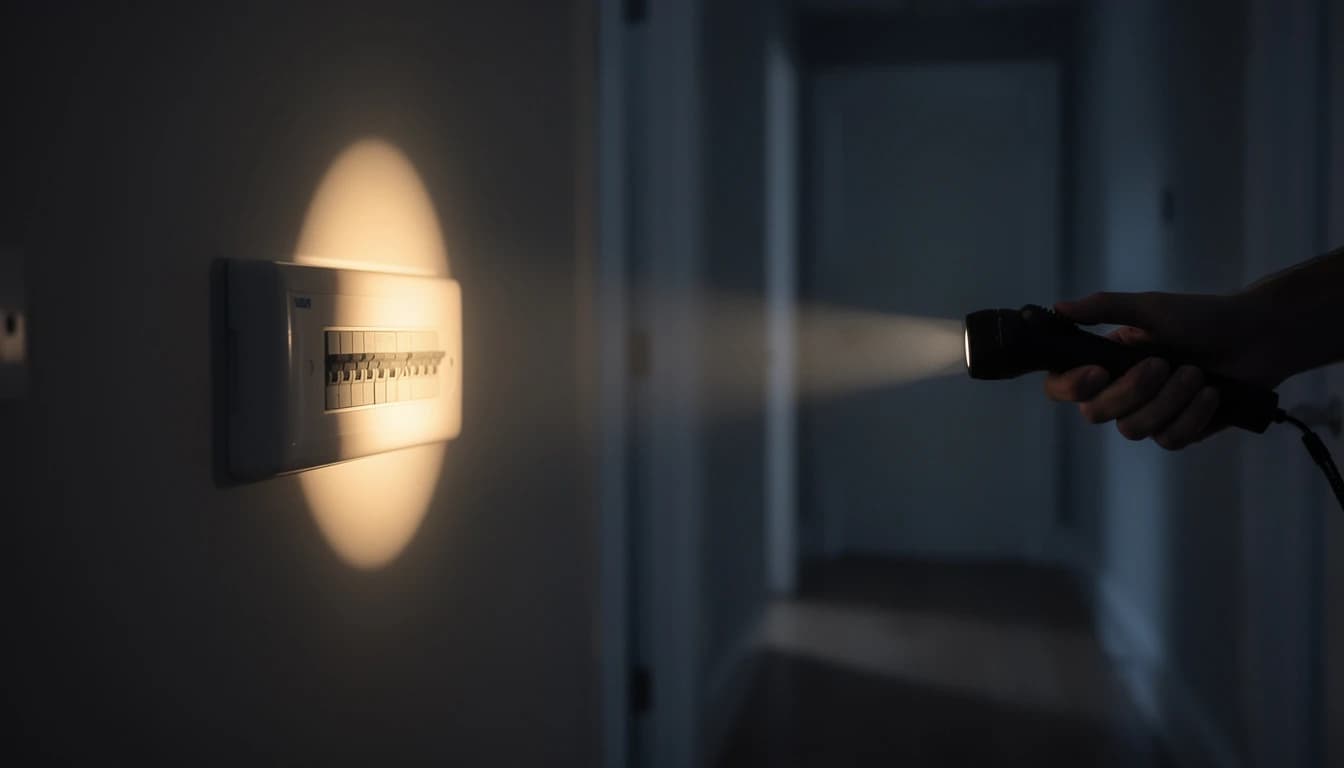
Look out the window first. If your neighbours' lights and the street lights are out too, it's a network power cut and you call 105. If everyone else has power and you don't, the problem is inside your property, and the answer is at your consumer unit or your meter. That one look saves you an hour of guessing.
We get called out to plenty of "emergencies" that turn out to be area-wide outages, and to plenty of people who sat in the dark for three hours waiting for a network that was never off. Here's how to tell them apart properly.
The two minute check, in order
- Look outside. Neighbours' windows, street lights, any shop signs. Dark street means network. This is the single most useful thing you can do.
- Check whether you've lost everything or just some things. If the sockets work but the lights are out, the supply is fine and one circuit has tripped.
- Find your consumer unit and get a torch on it. Look for a switch that's dropped down while its neighbours are up.
- Check the main switch. A single large switch, usually on the left. If that's off, everything downstream is dead.
- Look at your meter. A blank display where there's normally something showing points at the supply side rather than your installation.
Prepaid meter customers, add one more step. Check your credit before anything else. An empty meter looks exactly like a power cut and it's a far more common cause than either of them.
If it's a network power cut
Call 105. Official government advice on preparing for power cuts tells you to "write down the phone number to report a power cut, this is 105 in England, Scotland and Wales and 03457 643643 in Northern Ireland".
UK Power Networks, which runs the network across most of London, describes 105 as "an easy-to-remember number to call, that will put you through to your local electricity network operator who can help", and confirms it's "free from a mobile or landline phone". If you're in London, the South East or the East of England, their direct line is 0800 31 63 105.
Worth knowing: your electricity supplier, the company that bills you, does not fix power cuts. The network operator owns the cables and does the work. Calling your supplier just adds a step.
While you wait, the government advice is to keep "a battery or wind-up torch (and spare batteries) at home", noting that "torches are safer than candles", and to keep "fridges and freezer doors closed, as this will ensure they stay cold for several hours".
If someone in your household relies on electrical medical equipment or would struggle in an outage, sign up to the Priority Services Register. The government describes it as "a free service to help people who have additional needs", and it's run by your supplier and network operator. Do it before you need it.
If it's a fault in your property
Now the consumer unit is where the answer lives. What you find tells you what happened.
One breaker has tripped, the rest are on
A single circuit has a fault or was overloaded. Switch off and unplug everything on that circuit, then reset the breaker. If it holds, plug things back in one at a time and you'll find the culprit, usually an appliance rather than the wiring.
Our step by step on resetting a tripped fuse box safely covers this properly, including what not to do.
The RCD has tripped and taken half the board with it
An RCD covers several circuits, so one faulty appliance can kill lights and sockets across the house at once. It looks dramatic and usually isn't.
Unplug everything, reset, then reintroduce loads one by one. If it trips instantly with nothing plugged in, there's a fault in the fixed wiring and it needs testing. Our explainer on what an RCD does covers why it's so sensitive, and why fuse boxes keep tripping goes into the repeat offenders.
Everything is dead but the neighbours have power
Check the main switch is on. If it is, and the meter display is blank, the issue is between the network and your board. That's usually the service fuse or the supply cable, both of which belong to the network operator, not to you.
Call 105 for this too. It sounds like an internal problem and it isn't, and the network will attend a failed service fuse without charge. Never attempt to remove or replace a service head fuse. It's sealed for a reason and there's no protection between it and the substation.
Part of the house is dead with nothing tripped
This one is genuinely odd, and it's the one that usually means calling us. A loose connection at a junction or a socket can break a circuit without any protective device operating. Nothing has tripped because nothing has detected a fault, there's just a broken path.
These are the classic fault finding jobs. They're rarely obvious and almost never where people expect them to be.
Warning signs that mean stop and call someone
Most outages are inconvenient rather than dangerous. These aren't.
- Burning or fishy smell anywhere near the board, a socket or a switch. Isolate if you can do it safely and call an electrician. Our post on a burning smell from a socket explains what's happening.
- Buzzing, crackling or arcing sounds. Electrical Safety First advises not to ignore "burn marks, 'arcing' (buzzing or crackling) sounds, fuses blowing, circuit-breakers tripping, or if it feels hot to touch".
- Anything warm to the touch: a socket, a switch plate, the board itself.
- Visible scorching or discolouration around a socket or in the consumer unit.
- A breaker that won't stay in after everything is unplugged.
- Water anywhere near the installation. A leak above a consumer unit is an emergency, not a job for the morning.
Any of those and it's an emergency electrician call rather than a reset and hope.
Why "it's just a power cut" costs people money
The assumption goes both ways and both are expensive.
Assume it's the network when it's your wiring and you sit in the dark waiting for a restoration that was never coming, sometimes overnight. Assume it's your wiring when it's the network and you pay for a callout to be told the street is off.
The window check settles it in ten seconds. If it's dark outside and dark inside, put the phone down and call 105. If the street lights are on, get the torch out and look at your board.
Being ready for the next one
Small things that make a real difference at eleven at night.
- Know where your consumer unit is and make sure you can get to it without moving a wardrobe.
- Label the circuits. Most boards in London are labelled wrongly or not at all, and it turns a two minute job into twenty.
- Keep a torch near the board, not in a drawer in another room.
- Save 105 in your phone and your network operator's direct number alongside it.
- Test your RCD twice a year using the test button. It should trip instantly. If it doesn't, it isn't protecting you.
If your board is old enough that half of it is a mystery, our guide on whether your fuse board is safe is a good place to start.
Frequently asked questions
Is calling 105 free?
Yes. UK Power Networks confirms it's free from a mobile or landline, and it connects you to whichever network operator covers your area automatically.
Should I call my energy supplier during a power cut?
No, they don't maintain the cables. The distribution network operator does, and 105 puts you straight through to the right one.
Why is my house the only one without power?
Usually your main switch, a tripped device, an empty prepayment meter, or a failed service fuse. Check in that order, and if the meter display is blank with the main switch on, report it to the network.
Can I replace the fuse in my meter box myself?
No. The service fuse is the network operator's property and is sealed. There's no protective device between it and the substation, so the fault energy available is enormous. Call 105 and they'll attend.
How long will food keep in a power cut?
Government advice is to keep fridge and freezer doors shut, which keeps them cold for several hours. Every time you open the door to check, you shorten that.
My power came back but some sockets still don't work. Why?
The return of supply can trip an RCD, or a circuit may have failed during the outage. Check the board first. If everything is on and a circuit is still dead, that's a genuine fault and needs investigating.
Lost power and the street lights are still on? That one's yours, and we can find it. See our emergency electrician service or call 020 3653 2600. Real person on the phone, anywhere in London, and a straight answer on what it'll cost before we start.
Related reading
Immersion Heater Not Working? How to Find the Fault
No hot water from the immersion? The thermostat trips out far more often than the element fails. Here's how to tell them apart before you pay for the wrong part.
Read moreElectric Shower Not Working? Here's What's Usually Wrong
Dead shower, cold water or one that cuts out mid-wash. The faults behind each symptom, the two safe checks you can do, and when to stop and call someone.
Read more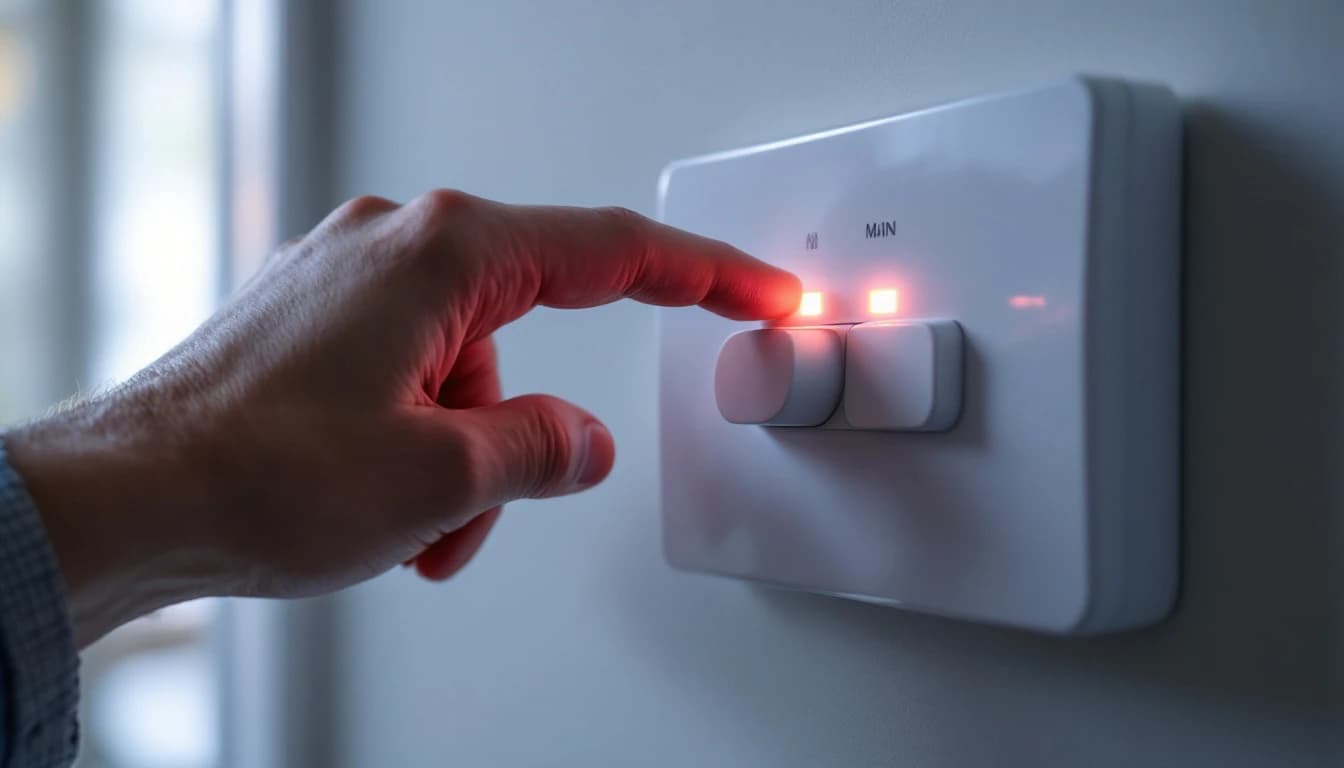
How to Reset a Tripped Fuse Box or RCD Safely
Your fuse box has tripped and half the house is dark. Here's how to safely reset the main switch or RCD, trace the faulty appliance, and know when to stop and call us.
Read more