
How to Reset a Tripped Fuse Box or RCD Safely
Your fuse box has tripped and half the house is dark. Here's how to safely reset the main switch or RCD, trace the faulty appliance, and know when to stop and call us.

By Yousif Al-Imari
Senior Engineer•22 July 2026
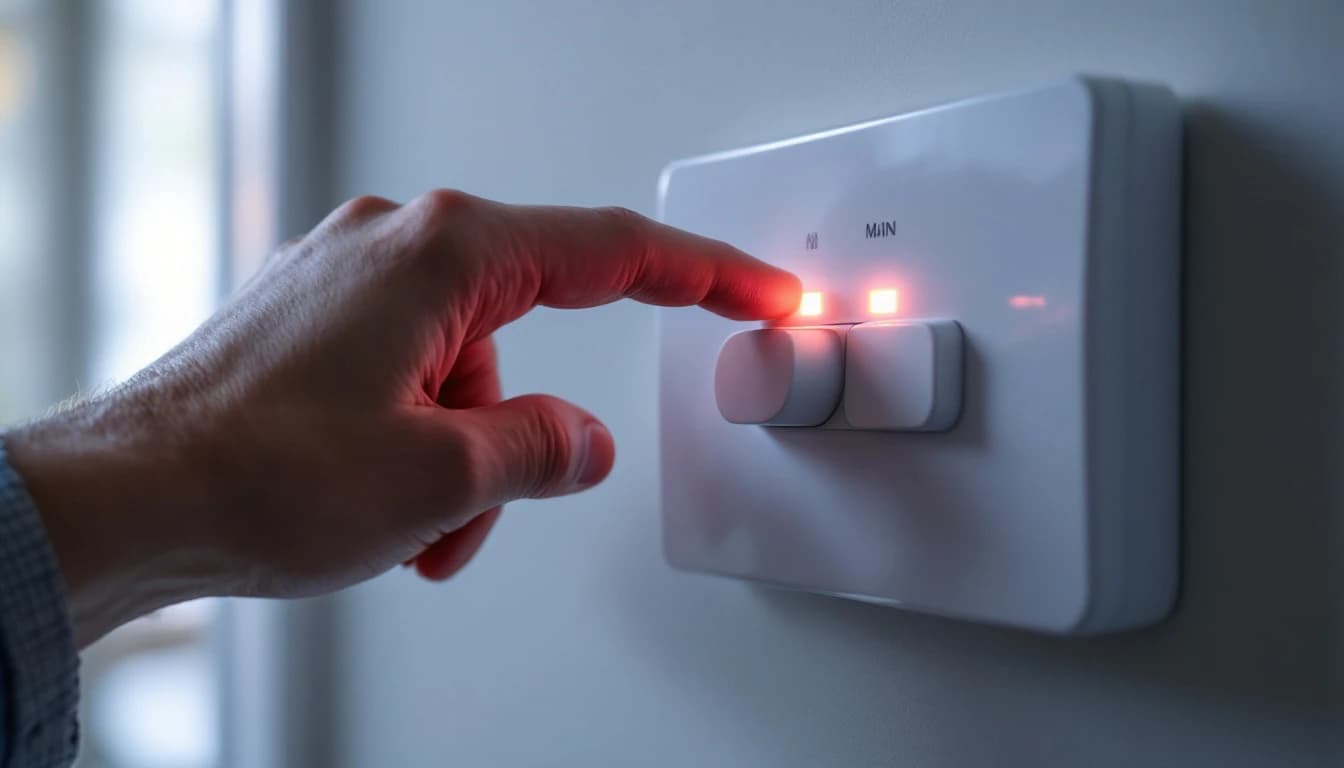
A tripped fuse box usually resets in under a minute. Open the consumer unit cover, find the switch that has flicked down to off, and push it firmly back up to on. If it holds, you're sorted. If it trips straight back down, the fault is still live and you'll need to track down what's causing it before the switch will stay up.
That's the short version. Below is the safe way to do it step by step, how to find the appliance or circuit at fault, and the point where you should stop touching it and call us. If nothing at your board has tripped at all, the problem may not be yours, and our guide to telling a power cut from your own fault sorts that out in two minutes. Half the house going dark is annoying. On its own it's rarely dangerous. But a handful of warning signs mean hands off, and we'll come to those.
First, work out what's actually tripped
Modern London homes don't have old fuse wire any more. You've got a consumer unit full of switches, and three different types can drop:
- The main switch: the big one, usually at one end of the board. It kills power to everything. If this is off, the whole house is dead.
- An RCD: a slightly larger switch that watches for current leaking to earth, the kind that can give you a fatal shock. It guards a group of circuits, so when it trips several things go off at once.
- An MCB, or circuit breaker: one of the row of small switches. Each protects a single circuit, like the upstairs sockets or the kitchen ring. If just one has dropped, only that circuit is off.
Which one has gone tells you a lot. A single MCB down is usually a single-circuit problem. A whole RCD down means the fault could be on any of the circuits sitting beneath it. If you're not even sure your board is up to modern standards, it's worth checking whether your fuse board is still safe while the cover's open.
Before you open the cover
Thirty seconds of care first. Dry your hands. Make sure you're not standing on a wet floor or in a puddle under the meter cupboard. Grab a torch or your phone light, because if the lighting circuit has gone you'll be doing this in the dark.
One rule matters more than any other. You only ever touch the switches on the front of the unit. Don't unscrew anything, don't pull the front panel off, and don't touch any wiring. Everything here is done with the flap open and your fingers on the switches, nothing else.
How to reset a tripped fuse box, step by step
- Unplug whatever was running. Think about what was on the moment it tripped: the kettle, the iron, a tired old phone charger. Switch it off at the wall and unplug it. This stops the board tripping straight back the instant you reset it.
- Open the consumer unit cover. Flip down the plastic flap. You're looking for the switch sitting in the off position, or halfway, or showing a little red marker.
- Push it fully off, then back on. Firmly push the tripped switch down to off first, then back up to on. You'll feel a click. Same goes for a tripped RCD or the main switch.
- Check the power is back. Lights on? Sockets working? If yes, close the cover. You're done.
- Reconnect appliances one at a time. Plug things back in slowly, one item then a pause. If the board trips the second a particular appliance goes back on, you've found your culprit. Leave it unplugged and get it repaired or replaced.
Nine times out of ten that's the whole job. A one-off trip after a bulb blew or the toaster gave up is normal. The board did exactly what it was built to do.
If it trips again straight away: find the faulty circuit
Switch won't stay up? Don't sit there flicking it on and off. If it keeps tripping the fault is still there, and forcing it achieves nothing. Electrical Safety First is blunt about it: if the RCD in your fusebox keeps tripping, there's likely a fault with an appliance or the wiring that a registered electrician needs to investigate.
You can still narrow down which circuit is at fault yourself, and it's genuinely useful information to hand an electrician. Here's the method:
- Switch all the small MCBs to off.
- Reset the RCD, or the main switch, back to on. With every circuit isolated it should hold.
- Switch the MCBs back on one at a time, pausing after each. When one of them makes the RCD trip again, that's the circuit carrying the fault.
- Leave that one off. Switch the rest back on so the rest of the house has power.
Now you know whether it's the kitchen, the upstairs sockets, the outside lights, wherever. Sometimes it's a single dodgy appliance on that circuit and unplugging it fixes everything. Sometimes it's the wiring, and that's where you want a professional. Our fault-finding and repair service is built for exactly this, tracing the root cause rather than guessing at the symptom. If it's happening over and over, we've gone deeper into why a fuse box keeps tripping.
Stop right now and call an electrician if you notice this
Resetting a switch is fine. What follows is not a reset job, and pushing on can turn a small fault into a fire or a shock. If you see, hear, or smell any of these, leave the unit alone and get a professional out:
- A burning or hot-plastic smell, or a fishy odour near the board or a socket.
- Scorch marks or brown discolouration around the consumer unit, a plug, or a socket.
- Buzzing, crackling, or sizzling. Electrical Safety First lists arcing sounds, burn marks, and anything hot to the touch as signs you shouldn't ignore.
- Anything warm or hot to touch: a socket, a plug, or the unit itself.
- Water anywhere near it. A leak, a flood, a damp meter cupboard. Don't touch the board. If you can safely reach the main switch, turn everything off, then call.
- The main switch or RCD simply won't stay up, even with every circuit switched off. That points to a fault on the incoming supply or a failed device, not something a reset will fix.
A burning smell especially is one to take seriously, and we've explained what's usually behind a burning smell from a socket. When it's this kind of thing, it's an emergency electrician call, day or night. Better a wasted callout than a house fire.
Stopping it happening again
Test that RCD now and then. Look for the button marked 'T' or 'Test' on the front of the unit. As Electrical Safety First explains, pressing it should instantly cut the power to the circuits that RCD protects. If it does, the device is working and you simply reset it. If holding the button in does nothing, the RCD itself may have failed and needs a registered electrician to look at it.
A board that trips for no obvious reason, or an older unit with no RCD at all, is worth a proper inspection. If yours is ageing, or it's one of those old rewireable fuse-wire boards, upgrading to a modern board brings the protection up to current standards and usually ends the mystery trips for good.
Frequently asked questions
Why won't my fuse box switch stay up?
Because the fault it tripped on is still connected. A breaker or RCD is designed to refuse to reset while there's a live fault, that's the safety doing its job. Unplug the appliances on that circuit, then try again. If it still won't hold with everything unplugged, the problem is in the wiring and needs an electrician.
Is it safe to reset a tripped fuse box myself?
Yes, as long as you only touch the switches on the front, your hands are dry, and there's no burning smell, scorch marks, buzzing, or water involved. Resetting a switch is a normal household job. Opening the unit, touching wiring, or forcing a switch that keeps dropping is not.
How many times can I reset a tripped breaker?
Once, maybe twice. If it trips, resets, and holds, fine. If it trips straight back a second time, stop. Repeatedly forcing a breaker back on doesn't fix anything and can make a developing fault worse. At that point work out which circuit it is and get it checked.
Why do several things turn off at the same time?
Because an RCD protects a whole group of circuits at once, not just one. When it trips, everything sitting beneath it goes dark together, which is why a single faulty kettle can knock out half the house. A single MCB, by contrast, only ever takes out its own circuit.
Should I still call an electrician if it reset fine and everything works?
If it was a clear one-off, like a bulb blowing, probably not. But if the same circuit trips every few days, or it goes for no reason you can pin down, that's a pattern worth investigating before it becomes a bigger job. A quick fault-find now is cheaper than an emergency later.
Based anywhere in London and the board won't behave? See our emergency electrician service or call us on 020 3653 2600 for a straight answer and a fixed quote agreed before any work starts.
Related reading
Plug Socket Not Working? How to Find the Fault Safely
One dead socket or a whole room? The answer changes everything. How to check the consumer unit, test safely, and spot the loose connection we find most often.
Read moreBathroom Extractor Fan Not Working? Causes and Checks
A dead bathroom fan is usually a tripped isolator, a failed timer, a seized motor or a blocked duct. Here's how to tell which, and what you can safely check.
Read moreImmersion Heater Not Working? How to Find the Fault
No hot water from the immersion? The thermostat trips out far more often than the element fails. Here's how to tell them apart before you pay for the wrong part.
Read more