
Outside Light Not Working? Safe Checks Before You Call
Outside light or PIR security light not working? The safe order to check it, from the indoor switch and sensor dials to the rainy-night RCD trip that means it's time to call us.

By Yousif Imari
Senior Engineer•28 October 2026
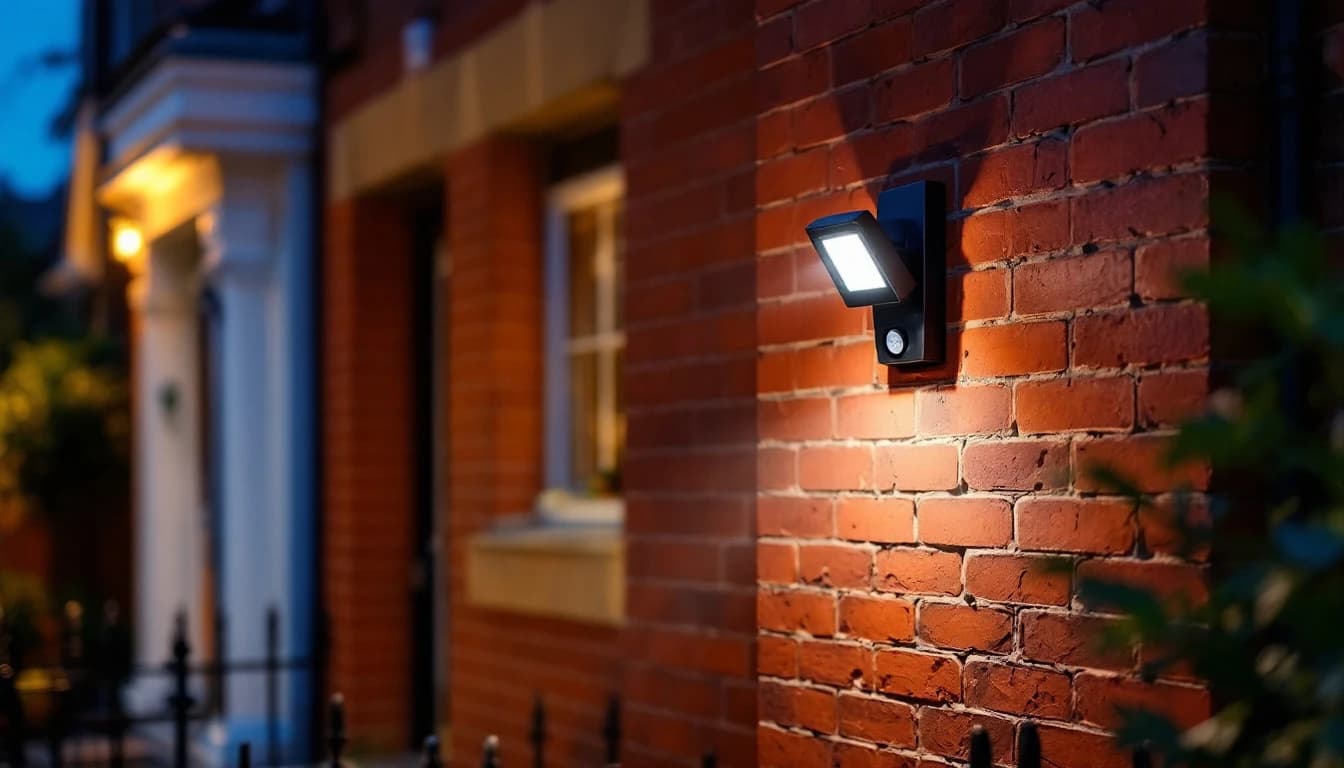
If your outside light isn't working, start with the indoor switch and any override mode, then look at the sensor's settings and what it can see. If the fitting has no bulb to change, or the RCD trips every time it rains, stop there and call an electrician.
Plenty of outside lights that look broken aren't. They've been switched off indoors, or set up in July when the evenings were light. Here's how to tell, without opening anything or going near the wiring.
Start indoors: the switch and the override
Lots of PIR security lights are wired through an ordinary switch inside the house, and that switch has to stay on for the sensor to work. Someone turns it off thinking it's the hall light, and the floodlight looks dead for weeks.
The same switch often controls an override. On Timeguard's LED10PIRB floodlight, flicking the indoor switch off and on twice within 2 seconds keeps the light on for 6 hours, or until dawn. Once within 2 seconds puts it back to automatic, according to Timeguard's instructions. A light that's stuck on may simply be in the wrong mode.
Then try a power-up test. Switch off at the indoor switch, wait a good few seconds so you don't trigger the override, and switch back on. That floodlight, and Timeguard's LED88PIRN bulkhead, light up for about 30 seconds while the sensor warms up. If yours lights up, power is reaching it, so the answer is in the settings or the position. If nothing happens, check the consumer unit for a tripped breaker or RCD and reset it once. If it trips straight back, leave it off and read our guide to why a fuse box keeps tripping.
PIR sensor light not working? Check the dials
A PIR sensor light that won't come on, or won't go off, is very often a settings problem. Most have a dial for how dark it needs to be (lux or dusk level) and one for how long it stays on. Here's the range on a typical LED floodlight.
- Time on: 2 seconds to 30 minutes after movement stops
- Lux (darkness) level: 2 to 200 lux
- Detection range: up to 10 metres, mounted at 2.5 metres high
- Detection angle: 140 degrees
- Sensor warm-up: about 5 to 10 seconds
- Manual override: two off/on switches within 2 seconds gives 6 hours on
Source: Timeguard LED10PIRB and LED20PIRB installation instructions.
Electrical Safety First advises switching the power off before adjusting or checking outdoor lighting. So make small changes with the light off at the switch, then switch back on and test once it has warmed up. Only touch dials you can reach on the outside of the sensor from firm ground. If it means taking a cover off or climbing to a first-floor floodlight, leave it to us.
Lux set too dark, or too light
Turn the lux dial towards the moon and the light only works in proper darkness, so next to a streetlight it may never decide it's night. Towards the sun, it comes on in daylight. Timeguard's LED88PIRN leaves the factory set to the moon with the time at its minimum, about 5 seconds, so a new fitting can seem half-dead until someone adjusts it.
The dials don't all turn the same way. On the LED10PIRB the sun end is fully clockwise, while on the LED88PIRN you start fully anti-clockwise and turn clockwise at dusk. Check the instructions for your exact model.
Time set to "D", or to almost nothing
The LED88PIRN's time dial has a "D" position at its far end. Set there, the motion detector stops working and the light runs from dusk to dawn. If your security light burns all night and ignores movement, look for that. Set to a few seconds, it switches off while you're still finding your keys.
Sensitivity and range
Some fittings add a sensitivity dial. Timeguard's TG6001 PIR wall light has a middle dial that varies sensitivity and range up to 7 metres. Turning it down to stop the neighbour's cat setting it off also shortens how far it sees.
What the sensor can and can't see
A PIR sensor reacts to a moving body crossing one of its detection zones, and Timeguard's manuals point out it's more sensitive to movement across its view than to someone walking straight towards it. A floodlight aimed straight down a path can be slow to notice the person walking up it. The manuals also list what confuses a sensor:
- Heat sources in view: boiler flues and tumble dryer vents
- Other lights opposite: including another security floodlight
- Reflective surfaces: puddles and white-painted walls
- Overhanging branches: can cause false activation in rough weather
- Constant false triggering: keeps resetting the timer, so the light seems stuck on
- Shadow over the sensor: can switch the light on in daylight
Source: Timeguard LED10PIRB and TG6001 instructions, positioning and troubleshooting sections.
Then there's whatever has grown or moved since it was fitted, like a hedge that filled out over summer or a new fence panel between the sensor and the path. A grubby lens doesn't help. Electrical Safety First's outdoor lighting advice is to keep fittings clean and free from leaves and dirt, and Timeguard says a dry cloth only, no liquid cleaners.
The LED floodlight that won't take a new bulb
Some outside lights take an ordinary bulb. Some LED fittings don't. Timeguard's LED88PIRN bulkhead lists a "6.5W LED non replaceable lamp" in its specification. When fittings like that fail, the whole unit gets replaced. There's nothing to buy at the hardware shop.
If yours takes a bulb, such as a wall lantern, you can try a new one if you can reach it without unscrewing a sealed cover. ESF says switch off before changing any lamp. If the bulb sits behind a gasket or a screwed-on lens, leave it, because that seal is part of what keeps the rain out.
If you bought it cheaply online, check ESF's recall list, which includes a 30W PIR LED floodlight sold on Amazon, found to be a serious fire risk with earthing that could let metal parts become live. If it's time for a new fitting, our guide to the best outdoor lighting for UK homes covers what's worth buying.
When rain gets in: RCD trips and wet fittings
This is the pattern that matters most. The light works on dry evenings, then the RCD trips on wet ones. That's usually water getting into the fitting or its cable and letting current leak to earth. An RCD is built to cut the power when it detects a leaking current, as ESF's guide to RCDs explains. The RCD is doing its job. The fitting isn't.
- Keep your hands off a fitting that's wet inside or visibly damaged. ESF's garden advice is not to use electrical equipment outdoors until it's dry, even if there's only dew on the ground.
- Don't keep resetting. An RCD that trips again on the next wet night is telling you something.
- Switch it off and get it repaired. ESF says faulty outdoor lighting should be switched off straight away and repaired by a registered electrician.
- Don't jet-wash around it. NICEIC's bathroom guidance notes a higher water rating may be needed where equipment faces water jets during cleaning, and a pressure washer outside is the same problem.
A light that trips the power every rainy night needs fault finding, not another reset. Our fault finding and repairs service traces where the water is getting in so it stays fixed.
IP ratings: the number only works if it's fitted right
Our guide to outdoor sockets and garden lighting covers which rating to choose. For fault finding, what matters is what your existing light was built to cope with.
- First digit: protection against solids such as dust
- Second digit: protection against water, where 0 means none
- IPX4 or IPX5: splash-proof
- IPX7: protected against immersion at 1 metre for up to 30 minutes
- Timeguard TG6001 PIR wall light: IP44
- Timeguard LED10PIRB floodlight: IP55
- Timeguard LED88PIRN bulkhead: IP55, "suitable for restricted external applications"
Sources: NICEIC, Bathrooms and electrics (IP ratings section); Timeguard instructions for each model.
The rating assumes the fitting went up as designed. Timeguard tells installers to use the grommets to maintain the IP rating and to fix the back box the correct way up. Miss either and an IP55 light can still let water in.
Timers and smart controls
If the light runs on a timer, bear in mind the clocks went back on Sunday 25 October 2026, according to the gov.uk clock change dates. A timer that doesn't adjust itself for British Summer Time is now an hour out. Photocells and PIRs set to "D" go by light level, not the clock, so check shading and the lux setting instead. On a smart switch or bulb, check the app's schedule and whether it has dropped off your wifi. Smart switches have their own quirks, covered in our post on smart switches and the missing neutral.
When to call an electrician
- The RCD or a breaker trips when it rains, or straight after a reset.
- There's water or scorching inside the lens.
- The fitting is cracked or loose, or its cable is damaged.
- Power reaches it and the settings are right, but it still won't work.
Outside lights fall under Part P. Approved Document P names fixed lighting on outside walls as within its scope. Swapping an existing fitting is a replacement, so it isn't notifiable, but it must still meet BS 7671 (the IET Wiring Regulations). A new garden lighting circuit is notifiable. If you're planning new lights rather than fixing old ones, our lighting installation service can design it properly from the start.
Frequently asked questions
Why has my outside light suddenly stopped working?
Check the indoor switch and the override first, then the consumer unit. Switch off for a few seconds, then back on. Timeguard's PIR lights, for example, glow for about 30 seconds while warming up, which proves power is getting there.
Why is my PIR sensor light not coming on at night?
Usually the lux dial is set too dark, a nearby light stops the sensor deciding it's night, or something blocks its view. It also picks up movement across its view better than movement straight at it.
Why does my security light stay on all the time?
It may be in override mode, set to a dusk-to-dawn "D" position, or falsely triggered by a boiler flue or swaying branches, which keeps resetting the timer.
Why does my outside light trip the electrics when it rains?
Water is almost certainly getting into the fitting or its cable, and the RCD is cutting the power because current is leaking. Don't touch it or keep resetting. Switch that circuit off and call an electrician.
Can I replace the bulb in an LED floodlight?
Often not. Some LED fittings have the LEDs built in, and Timeguard lists the lamp in its LED88PIRN as non-replaceable. When a fitting like that fails, the whole unit is replaced.
Do I need an electrician to replace an outside light?
A like-for-like swap isn't notifiable under Part P, but it must meet BS 7671, and Electrical Safety First recommends a registered electrician installs outdoor lighting. New circuits are notifiable and need certifying, which a registered electrician can do themselves.
Outside light still dead, or tripping the power every time it rains? See our fault finding and repairs service or call us on 020 3653 2600 for a straight answer and a fixed quote, anywhere in London.
Related reading
Light Switch Not Working? A Safe Way to Find the Fault
A calm, safe order of checks for a light switch or dimmer that has stopped working, plus what a warm, crackling or sparking switch really means and when to call an electrician.
Read morePlug Socket Not Working? How to Find the Fault Safely
One dead socket or a whole room? The answer changes everything. How to check the consumer unit, test safely, and spot the loose connection we find most often.
Read moreBathroom Extractor Fan Not Working? Causes and Checks
A dead bathroom fan is usually a tripped isolator, a failed timer, a seized motor or a blocked duct. Here's how to tell which, and what you can safely check.
Read more