
Heat Alarm in the Kitchen: Where to Fit It and Why
Why a kitchen needs a heat alarm rather than a smoke alarm, how heat alarms decide when to sound, where exactly to fit one, and what landlords in England must provide.

By Ali Elm
Managing Director•14 October 2026
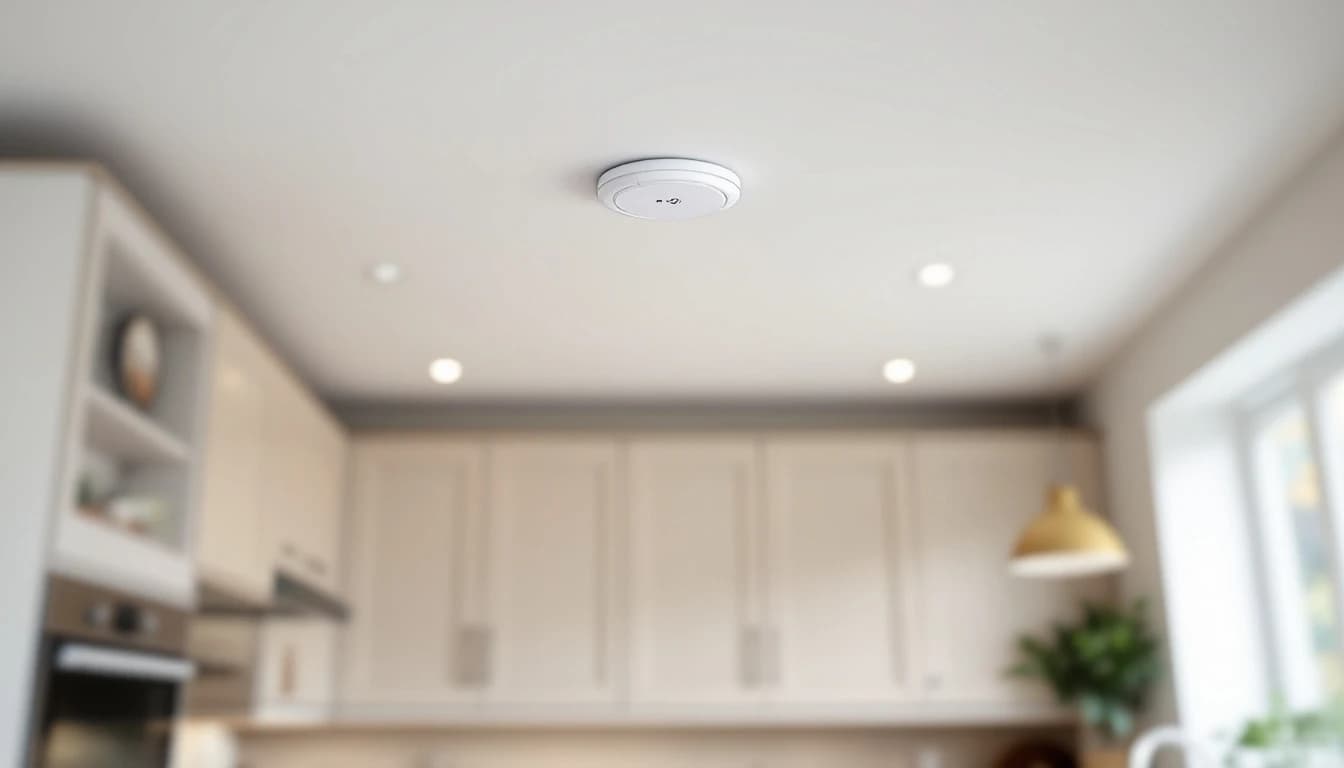
Yes, your kitchen should have a heat alarm rather than a smoke alarm. A heat alarm ignores steam and burnt toast and only sounds when the room itself gets dangerously hot, at 58°C on popular models. Fit it on the ceiling, as central as you can, and at least a metre from the hob.
For the room-by-room rules across the whole home, see our guide to smoke alarm regulations in the UK. This one stays in the kitchen, from exactly where the alarm goes to what landlords actually have to fit.
Why smoke alarms and kitchens don't get on
A smoke alarm is built to notice tiny particles in the air, and a kitchen makes plenty of those every time someone sears a steak. London Fire Brigade advises fitting smoke alarms away from kitchens and bathrooms because steam can damage the alarm, or set it off by mistake, and recommends a heat alarm in the kitchen instead.
The false alarms matter more than the noise. An alarm that shrieks through every Sunday roast tends to end up with its battery in a drawer, and then the room where most fires start has no cover at all. LFB says around 60% of fires in the home start in the kitchen. The national figures for England point the same way.
- Accidental dwelling fires started by cooking appliances: 42%, down from 50% in the year to March 2011
- Dwelling fires where an alarm was fitted but didn't operate: 19%
- Dwelling fires where it operated but didn't raise the alarm: 10%
- Failures where fire products didn't reach a detector: 49%
- Failures where the fire was in an area the system didn't cover: 17%
- Failures down to a missing or defective battery: 1.8% and 3.1%
Source: MHCLG fire statistics, England, year ending March 2026.
Two thirds of the alarms that failed did so because the fire never reached them or started somewhere they didn't cover, and the report says the first can mean poorly sited alarms. A kitchen with nothing on the ceiling, relying on a hallway alarm behind a closed door, is exactly that gap. A heat alarm closes it without the nuisance.
How a heat alarm decides when to go off
Aico and FireAngel both build their kitchen heat alarms around a thermistor, a small temperature sensor. There are two ways a detector can use what it reads.
- Fixed temperature, Aico Ei3014: sounds when the sensor reaches 58°C
- Fixed temperature, FireAngel FA6720-R: sounds when the air around it reaches between 54°C and 65°C
- Rate of rise: sounds when the temperature climbs faster than a set amount per minute, typically 8°C to 12°C, whatever the actual reading
- Combination: both methods in one unit, which many modern UK installations now specify
Sources: Aico Ei3014, FireAngel FA6720-R and Johnson Controls.
Both household alarms above are fixed-temperature units, though some newer models blend the two: FireAngel describes its mains Spec+ heat alarm as triggering "at set temperatures or rapid rises".
There's a trade-off. A fixed-temperature detector waits until the air at the ceiling is genuinely hot, and Johnson Controls notes it "may respond more slowly in slow-developing fire scenarios". In a kitchen that's a fair trade, because the alternative is a smoke alarm nobody leaves switched on. Elsewhere it isn't, which is why government guidance for landlords says plainly that heat detectors are not a replacement for smoke alarms.
Where to fit a heat alarm in the kitchen
Position decides whether the alarm works and whether it nags. These are manufacturers' figures, with Aico tying its sloped-ceiling advice to BS 5839-6, the British Standard for home fire alarms.
- Mounting: ceiling only, as Aico says its heat sensors cannot be wall-mounted
- Position: as central as possible, since Aico rates its heat alarms at a 5.3m radius of coverage
- Walls and light fittings: no closer than 300mm if it can't go in the middle
- Cooker, hob and appliances: at least 1m away, and never directly above the oven or hob
- Sloped or peaked ceiling: sensor between 25mm and 150mm below the ceiling, unless the drop from peak to eaves is under 600mm, in which case treat it as flat
- Room temperature: not anywhere that regularly goes above 38°C or below 4°C
Sources: Aico on heat alarms and FireAngel FA6720-R.
In a narrow London galley kitchen, those two distances can leave a small target, especially with downlights in the way. That's why we mark positions before anyone drills.
Open-plan kitchen-diners need more thought. Aico's summary of BS 5839-6 recommends a heat detector in every kitchen and a smoke detector in the principal habitable room, so one open space often ends up with both, heat over the cooking end and smoke towards the sofa. Aico's multi-sensor alarm, which pairs optical and heat sensors, is another option it says has an increased resistance to false alarms.
Linking it to the rest of the house
A heat alarm on its own only warns people who can hear it. Interlinked alarms fix that: LFB explains that when one alarm detects a fire, they all go off together, so a kitchen fire downstairs wakes the bedrooms upstairs.
In practice you match the kitchen unit to the brand already on your ceilings. Aico, for example, lists its Ei3014 heat alarm as fully compatible with its other alarms, whether they're hard-wired or linked by radio. When a linked system is tested, the "one alarm, all alarm" response is part of the check.
BS 5839-6 also sets how much of the home a system covers, using the LD categories you'll see on quotes.
- LD3, minimum protection: escape routes such as hallways and landings
- LD2, medium protection: escape routes plus high-risk rooms such as the kitchen and living room
- LD1, high protection: everywhere a fire could start, including bedrooms and airing cupboards
- New homes under Approved Document B: at least Grade D2, Category LD3
Sources: Aico's BS 5839-6 summary and Approved Document B, volume 1.
So the kitchen is one of the rooms that lifts a system from LD3 to LD2. Building regulations set LD3 as the minimum for most new homes. The British Standard goes further and recommends LD2 for rented homes.
What landlords in England must provide, and what's good practice
This is where people get caught out. The Smoke and Carbon Monoxide Alarm (England) Regulations 2015, tightened by the 2022 amendment from 1 October 2022, don't mention heat alarms at all.
- Required, smoke alarms: at least one on every storey with a room used wholly or partly as living accommodation
- Required, carbon monoxide alarms: in any such room with a fixed combustion appliance other than a gas cooker
- Required, checks: alarms working on the day a new tenancy begins, and repaired or replaced when a tenant reports one and it's found faulty
- Not required, heat alarms: and they can't stand in for the smoke alarm on that storey
- Not specified, alarm type: government guidance recommends alarms that comply with BS 5839-6, with sealed-for-life batteries where battery alarms are used
- Recommended for rented homes by BS 5839-6: Grade D1, Category LD2, with a heat detector in every kitchen
- Penalty: up to £5,000 per breach for failing to comply with a remedial notice
Sources: regulation 4, GOV.UK landlord guidance and Aico.
So if the only alarm on a floor is a heat alarm in the kitchen, the property doesn't meet the law. You still need a smoke alarm on that storey, normally in the hallway, with the heat alarm on top and interlinked. Licensed HMOs are covered through their licence conditions instead, and Scotland has its own, different rules, so this section is for England only. If you look after several lets, our landlord electrical services handle alarms alongside EICRs and certificates.
Mains-wired or sealed battery?
BS 5839-6 also grades systems by how they're powered.
- Grade D1: mains powered with a tamper-proof standby battery, such as Aico's Ei3014 with its 10-year rechargeable lithium back-up
- Grade D2: mains powered with a user-replaceable standby battery
- Grade F1: battery only, tamper-proof, such as FireAngel's FA6720-R with its 10-year sealed lithium battery
- Grade F2: battery only, with a battery you can replace yourself
Sources: Aico's BS 5839-6 summary, Aico Ei3014 and FireAngel FA6720-R.
LFB's view is straightforward: battery heat alarms you can fit yourself, hard-wired ones need an electrician, and heat alarms are available for around £10. For new homes and building work, Approved Document B expects mains-operated heat alarms to BS 5446-2, with a standby power supply.
Our honest take: in a rental, or anywhere the ceilings are coming down anyway, go mains with a sealed backup and interlink it. In an owner-occupied flat with no work planned, a sealed 10-year battery heat alarm that links by radio to your other alarms is a real step up. Mains costs depend mostly on how easily we can reach a suitable supply, so ask our smoke and heat alarm installation team for a fixed quote.
Testing, cleaning and replacing
- Test: at least monthly according to Aico and BS 5839-6, or weekly according to FireAngel
- How: press and hold the test button for up to 10 seconds
- Linked systems: every alarm should start sounding within 10 seconds of the first
- Clean: every 6 months for Aico heat alarms, or every 3 months for FireAngel, with a soft brush on the vacuum and no solvents
- Replace: Aico alarms have a ten-year lifespan, and FireAngel says replace by the date on the unit, as after it the sensor reacts less efficiently
Sources: Aico testing guide, Aico on heat alarms and FireAngel.
Don't reach for a lighter or a hairdryer. Aico says pressing the test button simulates the effect of smoke or heat and checks the alarm from sensor to sounder. A chirp is different. It's a maintenance signal: on the FA6720-R, FireAngel says a single chirp usually means the sealed battery is reaching end of life. Our guide to smoke alarm beeping explains the other chirps.
Frequently asked questions
Should I have a smoke alarm or a heat alarm in the kitchen?
A heat alarm. Smoke alarms react to steam and cooking fumes, so London Fire Brigade recommends a heat alarm in the kitchen and smoke alarms elsewhere.
How far should a heat alarm be from the cooker?
Aico recommends at least 1m from the hob and other appliances, never directly above them. Keep it on the ceiling and at least 300mm from walls and light fittings.
Does a kitchen heat alarm count as the smoke alarm for that floor?
No. Government guidance for landlords says heat detectors are not a replacement for smoke alarms. You still need a smoke alarm on that storey, usually in the hallway.
What temperature does a heat alarm go off at?
Aico's heat alarms sound at 58°C and FireAngel's FA6720-R between 54°C and 65°C. Rate-of-rise detectors also react to a fast climb, typically 8°C to 12°C per minute.
Do heat alarms have to be hard-wired?
Not in an existing home, and LFB says you can fit battery ones yourself. New builds and building work call for mains alarms with a standby supply, and BS 5839-6 recommends mains for rented homes.
How long does a heat alarm last?
Usually ten years. Aico gives its alarms a ten-year lifespan and FireAngel prints a replace-by date on each unit.
Based anywhere in London and want a heat alarm fitted in the right spot and linked to the rest of the house? See our smoke and heat alarm installation service or call us on 020 3653 2600 for a straight answer and a fixed quote.
Related reading
What to Do in an Electrical Emergency (and Who to Call)
A shock, sparks, smoke or no power? What to do in the first minute, when to call 105 or 999, what can wait until morning and how emergency electrician pricing works.
Read more
Extension Lead Safety: 13 Amps, Daisy Chaining and Heaters
An extension lead shares one socket's 13 amps between everything plugged into it. Here's the simple maths, why daisy chaining causes fires, and when you need more sockets instead.
Read moreBS 7671 Amendment 3 and the 19th Edition: What Changed
Amendment 3 to BS 7671 took effect on 31 July 2024, Amendment 4 becomes the sole standard on 15 October 2026, and the 19th Edition has no announced date. Here's what any of it means for your home or rental.
Read more