
Does an Electric Cooker Need Its Own Circuit?
Most electric cookers and every electric hob need a dedicated circuit. Here is how to work out whether yours does, and what a proper cooker circuit involves.

By Yousif Al-Imari
Senior Engineer•29 July 2026
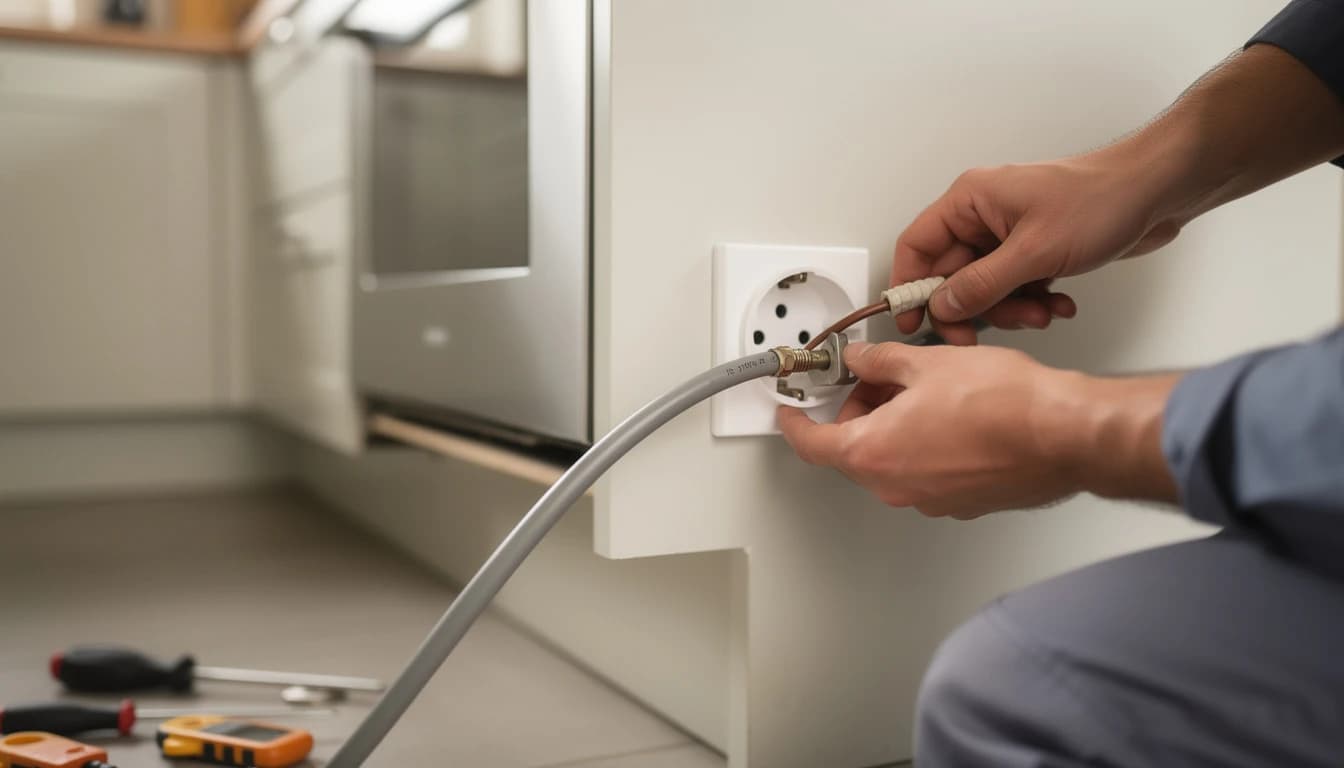
If your cooker draws more than 13 amps, it needs its own dedicated circuit run from the consumer unit. That covers every electric hob, every range cooker, and most freestanding electric cookers. A single built-in oven rated under about 3kW can usually be plugged into a normal socket, provided the manufacturer's instructions allow it.
The confusion usually starts in a showroom, where someone says "it just plugs in" about an appliance that very much does not. Here's how to check yours properly before the kitchen fitter arrives and finds there's nothing behind the wall.
The 13 amp line in the sand
A standard UK plug carries a 13A fuse. At 230V, that caps what you can safely pull through it at roughly 3kW. Anything hungrier needs hard wiring to a circuit sized for the job.
Where cooking appliances typically land:
- Single built-in electric oven: often 2.5kW to 3.5kW. Borderline. Check the plate.
- Double built-in oven: commonly 4kW to 6kW. Dedicated circuit.
- Ceramic or induction hob: usually 6kW to 7.4kW. Dedicated circuit, always.
- Freestanding electric cooker: typically 8kW to 12kW. Dedicated circuit.
- Range cooker: 11kW and upwards, sometimes needing two circuits.
The rating plate is your source of truth, not the marketing. It's usually on the door frame, the back panel, or inside the manual. Look for the total connected load in kW or the current in amps.
Converting kW to amps in your head
Divide the kilowatts by 0.23 and you have your amps, near enough. A 7.2kW induction hob works out at around 31A. A 3kW oven comes to about 13A, which is exactly why 3kW is the awkward borderline number.
Now, cookers don't run every element flat out at once, so electricians apply what's called diversity when sizing the circuit. That's a calculation set out in BS 7671, the wiring regulations published by the IET, and it's why a 12kW cooker doesn't need a 52A supply. It's also why you shouldn't size your own circuit off a rough guess. The calculation accounts for the appliance, the cable route and how hot that cable gets in a wall.
Can the oven and hob share one circuit?
Often yes, and it's how most fitted kitchens in London are wired. A single cooker circuit feeds a cooker connection unit, and both appliances terminate there.
It works when the combined load, after diversity, sits comfortably inside the circuit rating. A 3kW oven plus a 7kW induction hob on a 32A circuit is standard practice. Two double ovens plus a wide induction hob is where you start needing separate circuits, and a decent kitchen designer will flag it early.
What you can't do is bodge a hob onto the ring final circuit because the cooker cable is on the wrong wall. We see it, it trips constantly, and the cable runs warm behind the units. If your kitchen is being reconfigured, get the circuits planned at design stage rather than fixed afterwards.
What a proper cooker circuit actually involves
Four parts, and skipping any of them causes problems later.
- The breaker: commonly a 32A device in the consumer unit, sized against the load and the cable.
- The cable: usually 6mm² twin and earth for a 32A domestic circuit, though the route, insulation and length can push that to 10mm².
- The cooker switch: a 45A double pole isolator, sited within two metres of the appliance but not directly above the hob, so you're not reaching across a hot pan to turn it off.
- The cooker connection unit: the outlet plate low down behind the appliance where the flex terminates.
Cable size gets underestimated more than anything else. A 6mm² cable buried in thermal insulation on a long run through a converted loft may not be adequate, even though it's the textbook answer. That's the sort of thing that never shows up until the kitchen is finished and something starts running hot.
RCD protection matters here too. Cables buried in walls need it, and if your board doesn't provide it, a new cooker circuit is a good moment to look at replacing the board rather than bolting a workaround onto an old board.
Do you need building control involved?
Installing a new circuit in a dwelling in England is notifiable work under the Building Regulations. Replacing a consumer unit is too, and the government's own list of work needing approval includes "replace fuse boxes and connected electrics" on its building regulations approval guidance.
You don't have to make a separate application if the work is done by someone registered with a competent person scheme. That's how we do it: the circuit gets tested, certified and notified, and you get the paperwork. If you're weighing up doing it yourself first, read our post on what electrical work you can legally do before you buy any cable.
The certificate matters more than people expect. It surfaces during a house sale, during an insurance claim after a kitchen fire, and on any future electrical condition report.
Signs your existing cooker circuit isn't up to the new appliance
Plenty of London kitchens have a cooker circuit installed for a 1980s appliance that drew half what a modern induction hob does. The circuit is there, so people assume it's fine.
Worth checking before you order:
- The breaker is 16A or 20A rather than 32A. Common on older installations that fed a modest oven only.
- The cable is 2.5mm² or 4mm². Look at the thickness where it enters the cooker switch.
- The breaker trips when the oven and hob both come on.
- The cooker switch or the plate feels warm during use. That one needs looking at now, not next month.
- Discolouration around the terminals at the connection unit, which points to a loose connection cooking itself.
Warmth and browning at connections are the ones to take seriously. Loose terminals on a high current circuit are one of the more common causes of kitchen fires we get called to. If you can smell anything hot or acrid, our guide on a burning smell from a socket covers what to do straight away.
What it costs
Framing these as typical UK market ranges rather than our prices, since every kitchen is a different cable run.
- New cooker circuit, board to kitchen, straightforward route: around £250 to £450.
- Same job with a long or awkward run (upper floors, solid walls, finished decoration): £450 to £700.
- Upgrading an undersized existing circuit: similar to a new circuit, because the cable is what needs replacing.
- Cooker switch and connection unit only, where the circuit is already adequate: £90 to £180.
The cable route drives the price far more than the parts do. A ground floor kitchen backing onto the consumer unit cupboard is a couple of hours. The same job in a third floor flat with the board by the front door is a different day entirely. Get it quoted on site.
Frequently asked questions
Can I plug my electric oven into a normal socket?
Only if it's rated at or under about 3kW and the manufacturer's instructions permit it. Many single built-in ovens are supplied with a fitted plug for exactly this reason. If it came without a plug, that's your answer.
Does an induction hob need its own circuit?
Yes. Induction hobs typically draw 6kW to 7.4kW, far beyond what a plug or a ring circuit can supply. They also draw it in sharp bursts, which makes borrowing capacity from another circuit a poor idea.
How far from the hob should the cooker switch be?
Within about two metres of the appliance so it's usable in a hurry, and positioned to the side rather than directly above the hob. Reaching over a pan of hot oil to isolate a fault defeats the purpose of having the switch.
Can I use the old cooker circuit for my new range cooker?
Sometimes, but check the breaker rating and the cable size first. Range cookers commonly need more capacity than the circuit installed for a standard cooker, and some need two circuits. It's a ten minute check that avoids a very annoying delivery day.
Is a gas cooker with an electric ignition different?
Yes, much simpler. The electrical load is tiny, so a standard socket is fine. It's the oven and hob elements that create the demand, and a gas appliance doesn't have them.
What happens if I have a cooker installed without a certificate?
The work is unnotified, which can hold up a sale, complicate an insurance claim, and show up as a defect on a future inspection. Getting it certified retrospectively is possible but usually costs more than doing it correctly the first time.
Fitting a new kitchen or replacing an appliance and want the electrics right before the units go in? See our appliance installation service or call 020 3653 2600. We'll check what your circuit can take and quote a fixed price for anything that needs changing.
Related reading
Electric Shower Installation: Cost, Circuits and the Catch
What an electric shower install actually involves in a London home, why the consumer unit decides half the price, and the questions to ask before you book.
Read more
Running Power to a Garden Office, Shed or Garage
A garden office needs a proper buried supply and its own small board, not an extension lead. Here is what the job involves, what it costs and what the rules are.
Read more
Bathroom Extractor Fan Regulations: Zones, Ventilation and the Rules
What UK law actually requires for bathroom extractor fans: Part F ventilation rates, Part P notifiable wiring, and the BS 7671 zones and IP ratings that decide what goes where.
Read more